India’s pharma export resilience depends on connecting upstream supply risks with downstream execution. Enterprises need visibility from API sourcing and production planning through batch documentation, temperature monitoring, customs clearance, and final delivery. When these processes operate on connected data, teams can identify risks earlier, respond before commitments are missed, and improve export predictability without relying on separate, disconnected processes.
Key Takeaways
- Connect API resilience with export execution to manage disruption end to end.
- Reduce API dependency to protect production and export commitments.
- Strengthen documentation governance to avoid customs delays.
- Expand cold chain visibility beyond traditional biologics.
- Improve export predictability through end-to-end visibility and traceability.
Pharma is one of the few Indian export categories where volume leadership and supply chain fragility coexist without contradiction. India supplies roughly one-fifth of global generic medicine volumes and a majority share of vaccines used in immunization programs worldwide, a position independently confirmed by the India Brand Equity Foundation (IBEF), which reports India supplying around 20% of global generic medicine volume and 55 - 60% of UNICEF's vaccine requirement, alongside 99% of WHO's DPT (Diphtheria, Pertussis, and Tetanus). vaccine demand, yet a large share of the active pharmaceutical ingredients (APIs) that go into those medicines still originates from a narrow band of overseas suppliers.
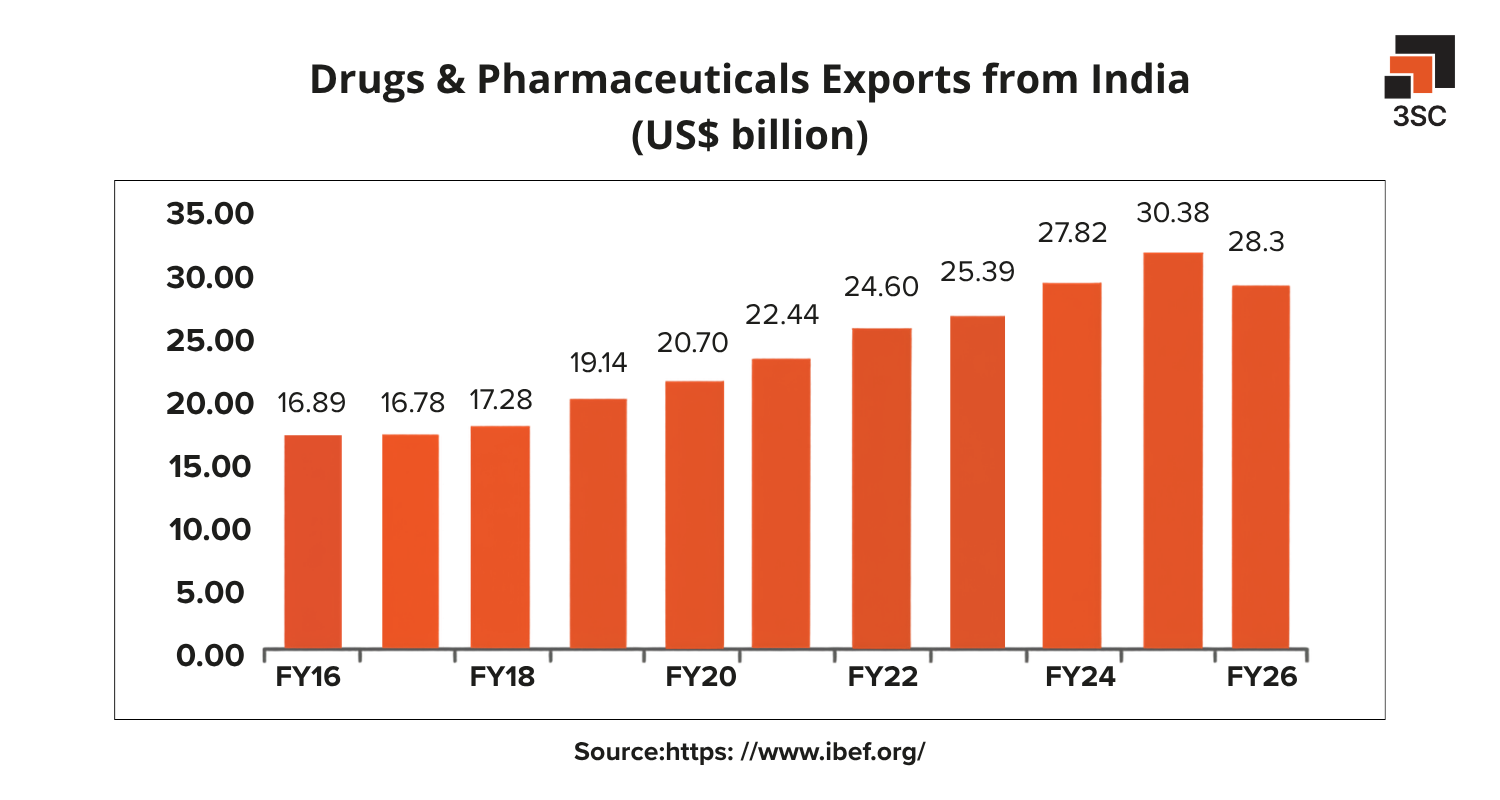
This gap between strong finished dose operations and weaker ingredient resilience is a key challenge for enterprise supply chains. It shows why API resilience and export reliability need to be addressed together, rather than as two separate priorities.
The API dependency problem is a scheduling problem, not just a sourcing problem
India's API dependency treats it as a sourcing diversification issue, find more suppliers, reduce concentration risk. That's necessary but incomplete. The sharper operational issue is that API lead times, regulatory clearances, and quality holds upstream don't stay upstream.
A delay in API customs clearance or a supplier's manufacturing shutdown ripples forward into finished-dose production schedules, and from there into export commitments that were made against buyer contracts signed months earlier.
Enterprises that manage API risk only as a procurement KPI, landed cost, supplier count, miss the fact that it's fundamentally a scheduling and commitment-reliability problem.
This is where API supplier risk monitoring needs to be integrated with production planning and export scheduling in the same system, so a supplier-side disruption is visible as an export-timeline risk the moment it occurs, not weeks later when a shipment misses its window.
A rerouted supplier or an expedited production run rarely leaves documentation untouched, however, a change in origin batch, plant, or shipping timeline typically means a change in which certificates, filings, and stability data apply, which is what pulls documentation onto the same critical path.
Documentation governance now sits on the critical path
Pharma exports depend on accurate documentation as much as the physical movement of products. Missing or mismatched documents can hold up compliant shipments at the border, turning a documentation gap into an export delay.
As Indian pharma companies enter more international markets, managing different documentation requirements manually becomes harder. Digital documentation governance can automatically collect, verify, and link required documents to each batch and shipment. This reduces errors, speeds up customs clearance, and lowers the risk of storage and demurrage costs.
Cold chain integrity is expanding beyond biologics
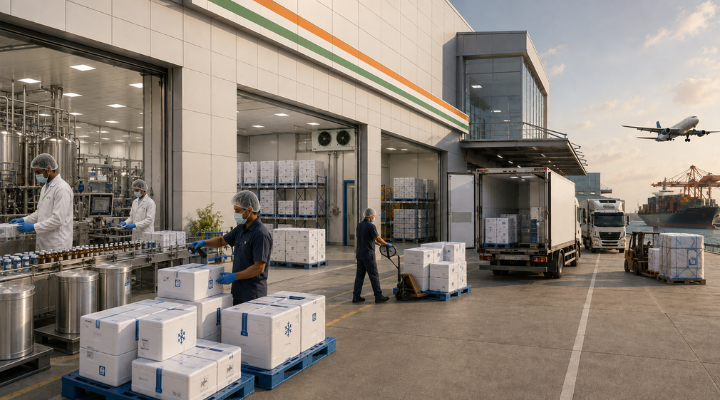
As India's pharmaceutical export mix becomes more complex, cold chain management is becoming relevant far beyond vaccines and traditional biologics.
Complex generics, biosimilars, and specialty formulations increasingly carry specific temperature and stability requirements, which means temperature-sensitive logistics are becoming a broader requirement across pharmaceutical exports rather than a concern limited to a handful of product categories.
The risk is not limited to a temperature excursion occurring in the first place. If an excursion goes undetected or undocumented, the issue may only surface during a destination-market audit, potentially after the batch has already entered distribution, at which point the compliance exposure is far harder to contain.
Managing this risk requires temperature visibility across the full chain: manufacturing, storage, port handling, transportation, and every handover point in between.
Continuous monitoring across these stages helps identify where an excursion occurred and which batch or shipment was affected and linking that temperature data to specific batches and shipments allows an excursion to trigger an immediate hold-and-review process rather than becoming a post-hoc compliance finding. This protects product quality, export eligibility, and customer confidence in one motion.
For pharmaceutical exporters, cold chain visibility is therefore becoming more than a compliance requirement, it is an important part of export reliability and long-term market trust.
Export predictability is the metric buyers are contracting against
Global pharma buyers are increasingly prioritizing delivery predictability alongside price and quality. Indian suppliers that consistently meet committed windows and provide end-to-end shipment visibility, from production release to destination handoff, are better positioned as reliable partners. With overseas healthcare systems operating under strict On-Time, In-Full (OTIF) expectations, inconsistent delivery can lead to penalties, lost contracts, and market share.
A single control tower, consolidating supplier risk signals, batch-level production data, documentation status, and shipment tracking into one visibility layer, is what lets exporters flag emerging delays early enough to renegotiate timelines proactively, rather than discovering the slip only when the shipment fails to arrive. In practice, that means:
- Multi-modal export visibility: integrating real-time ocean carrier vessel tracking, flight status updates, and port terminal congestion feeds into the same operational view maintained over supplier risk and documentation, rather than a separate system.
- Dynamic lead-time and ETA calculation: replacing static carrier transit times with machine-learning ETAs that account for port dwell times, transshipment delays, and seasonal weather disruptions.
- Proactive exception management: automated alerts that flag potential transit bottlenecks days in advance, giving logistics teams room to re-route freight or activate air-charter backup options.
- Total cost of delivery control: tighter execution governance reduces air-freight premiums caused by missed ocean cut-off times and mitigates port storage fees caused by delayed customs paperwork.
A buyer who receives a two-week advance notice of a slipping delivery window can adjust their own downstream planning; a buyer who discovers the slip only when the shipment fails to arrive re-evaluates the relationship entirely, regardless of how the underlying product performed.
When execution governance aligns transport operations with demand commitments this way, export predictability becomes a competitive differentiator in its own right, reinforcing India's reputation as a dependable global supplier.
Where this is heading through 2026 and beyond
Four shifts are converging to make integrated resilience non-negotiable rather than aspirational.
- First, regulatory scrutiny in major destination markets continues to tighten, particularly around data integrity and batch traceability, raising the documentation bar further.
- Second, geopolitical and trade-policy volatility affecting API-exporting countries means single-country dependency is now treated as a board-level risk conversation rather than a procurement footnote.
- Third, as the export basket itself shifts further toward complex generics and biosimilars, the cold chain and traceability demand described above will apply to a wider share of shipments, not a shrinking one, which raises the cost of treating temperature monitoring as a niche concern.
- Fourth, buyers are formalizing supplier scorecards that weight delivery predictability alongside cost and quality, which means exporters without real-time visibility infrastructure will structurally lose share to those who have it, even at comparable pricing.
The through-line across API resilience, documentation governance, cold chain integrity, and export visibility is that they all convert into the same outcome global buyers are pricing into contracts: reliability. Enterprises that govern these as one connected system, supplier risk feeding into production planning, batch tracking feeding into documentation, documentation feeding into export clearance, all visible on a single control tower, are the ones positioned to convert India's manufacturing scale into durable market trust, rather than repeatedly re-earning it after every disruption.
3SC helps pharmaceutical enterprises connect API supplier risk, production planning, inventory, batch-level documentation, and export logistics in one supply chain view. By linking upstream disruptions with their downstream impact, teams can identify risks earlier, adjust production or sourcing plans, track documentation and shipments, and manage exceptions before they affect customer commitments. This connected approach improves export predictability, reduces avoidable delays, and helps enterprises build greater reliability across their pharmaceutical supply chain.