Building a resilient supply chain requires identifying critical dependencies, establishing recovery timelines and aligning inventory with operational priorities. Businesses can strengthen resilience through flexible sourcing and production networks, scenario-based planning and clearly defined decision responsibilities. These strategies help minimise disruption, protect customer commitments, control costs and maintain business continuity amid changing supply chain conditions.
Key Takeaways:
- Identify critical supply chain dependencies and their business impact.
- Establish recovery timelines to enable timely intervention.
- Align inventory and production flexibility with operational priorities.
- Evaluate disruption scenarios to balance costs and service levels.
- Strengthen decision ownership and test operational preparedness.
Global supply chains are facing sustained pressure from geopolitical tensions, changing trade policies, volatile freight costs and unpredictable demand. Disruptions affecting major shipping routes, energy markets and manufacturing networks are creating uncertainty for businesses across industries.
The consequences often extend well beyond the immediate source of disruption. A change in energy prices can increase manufacturing costs, while restrictions along major trade routes can affect material availability, production schedules and delivery commitments across multiple regions.
According to KPMG's report on building shock-resilient supply chains, 70% of surveyed business leaders reported increased organisational risk exposure over the previous two years. The research also highlights how interconnected risks can amplify disruptions across industries and geographies.
For supply chain leaders, maintaining business continuity while controlling costs has become increasingly complex. Building a resilient supply chain requires a closer examination of operational dependencies, planning capabilities and the decisions that determine how effectively businesses respond when conditions change.
6 Strategies to Strengthen Supply Chain Resilience and Business Continuity
Supply chain resilience depends on how effectively businesses prepare for changing conditions and manage their operational consequences. These six strategies focus on strengthening capabilities that can protect service levels, improve financial performance and maintain continuity during disruption.
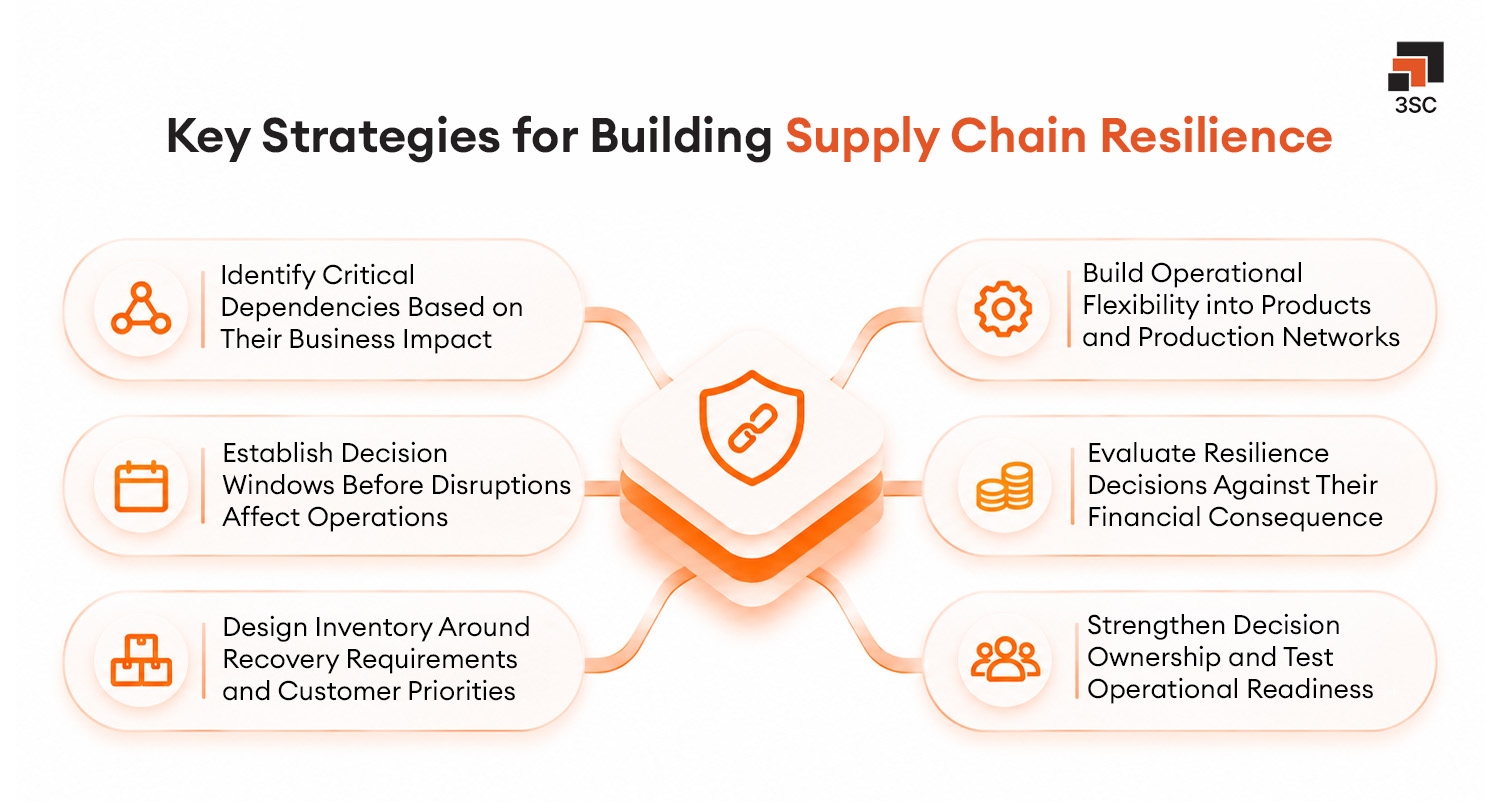
1. Identify Critical Dependencies Based on Their Business Impact
Supplier assessments often focus on purchase value, delivery performance and geographic location. However, these measures may overlook dependencies that have significant consequences for production and customer service.
A relatively inexpensive component, for example, may be essential to manufacturing several high-value products. Even a short interruption in its availability could affect multiple production lines and delay customer orders.
According to McKinsey's Supply Chain Risk Pulse, 95% of surveyed organisations had visibility into their immediate supplier risks, but only 42% had visibility extending into the second tier or beyond.
Mapping critical materials to upstream suppliers, manufacturing locations and transport routes helps uncover vulnerabilities. The assessment should also identify whether seemingly independent suppliers depend on common facilities or raw material sources.
Connecting these dependencies to revenue exposure and customer commitments helps prioritise risks according to their actual business impact and determine where additional protection is necessary.
2. Establish Decision Windows Before Disruptions Affect Operations
Identifying a disruption early offers limited value unless teams understand how much time remains before operations are affected.
Consider a manufacturer with enough inventory of a critical material for twelve days of production. If alternative supply requires twenty days, the organisation faces an eight-day gap that must be addressed before existing stock runs out.
Two measures help quantify this exposure. Time to Survive (TTS) estimates how long operations can continue during a disruption, while Time to Recover (TTR) measures how long restoring the affected capability will take.
Comparing these measures establishes intervention thresholds for critical materials and production processes. Procurement may need to initiate alternative sourcing, while manufacturing adjusts schedules to protect priority orders.
Clearly defined thresholds and escalation responsibilities allow teams to intervene while corrective options are still available, reducing the likelihood of disruption affecting production and customer commitments.
3. Design Inventory Around Recovery Requirements and Customer Priorities
Inventory can absorb supply interruptions, but increasing safety stock across every product creates unnecessary working capital pressure.
A more effective approach considers which materials need protection, how much inventory is necessary and where it should be positioned.
Also, two components may have similar demand patterns but different replenishment requirements. One may be sourced locally within days, while another depends on international procurement with longer lead times. Applying identical inventory policies to both may lead to excess stock in one category and inadequate protection in another.
Segmenting inventory based on demand variability, supplier reliability, replenishment lead times and product criticality helps establish appropriate buffer levels.
Inventory location is equally important. Concentrating stock at a central warehouse may reduce storage costs but limit accessibility during regional transport disruptions. Advanced inventory optimisation can support better stock allocation across locations, protecting critical operations while controlling the capital tied up in inventory.
4. Build Operational Flexibility into Products and Production Networks
Supplier diversification offers limited protection when alternatives cannot meet technical specifications, quality standards or required production volumes. Greater flexibility can be developed through product design and manufacturing arrangements.
For example, products dependent on specialised components may face prolonged interruptions when those materials become unavailable. Collaboration between engineering, procurement and production teams can help qualify alternative materials or standardise selected components, creating additional sourcing options.
Again, manufacturing flexibility also matters. Qualifying multiple facilities to produce critical products can reduce dependence on individual locations, provided equipment compatibility, workforce capabilities and quality requirements are addressed beforehand.
These arrangements involve additional investment, so priority should be given to products with substantial revenue exposure or critical customer commitments. Preparing alternative sourcing and production capabilities in advance enables faster operational adjustments when supply conditions change.
5. Evaluate Resilience Decisions Against Their Financial Consequences
For businesses, responding quickly to disruption may preserve customer service, but the fastest solution can increase operational costs.
Expedited freight, emergency procurement and additional production shifts may maintain product availability while putting pressure on margins. The financial implications, therefore, need to be considered alongside service requirements.
Scenario planning helps evaluate these trade-offs before committing resources.
During a material shortage, for example, available stock could be allocated to maximise production volumes, protect higher-margin products or fulfil strategically important customer orders. Each choice produces different consequences for revenue, inventory and service performance.
Evaluating these trade-offs requires an integrated view of operational and financial priorities, which is where Integrated Business Planning (IBP) plays an important role. By connecting demand, supply, inventory and financial planning, IBP enables organisations to assess these alternatives against common business objectives. AI-powered scenario analysis can further evaluate how changing constraints affect the wider supply chain, supporting decisions that protect operational continuity while considering profitability and working capital.
6. Strengthen Decision Ownership and Test Operational Readiness
An appropriate response can still be delayed when responsibilities are unclear or functional priorities conflict. Procurement may recommend an alternative supplier, while manufacturing requires technical validation and finance needs to approve additional expenditure. Without defined decision rights, coordinating these activities can consume valuable response time.
Clear responsibilities for sourcing changes, production adjustments, inventory reallocation and exceptional expenditure help teams respond within established authority limits.
Connected planning systems and risk intelligence can support coordination by providing consistent information about emerging constraints and available responses.
These processes should also be tested through realistic disruption scenarios. Simulating simultaneous supplier shortages, transport delays and demand changes can reveal weaknesses in capacity, approvals and execution readiness. Tracking recovery time, response costs and order fulfilment during these exercises provides measurable insights for improving contingency procedures and operational preparedness
Conclusion: Make Resilience Part of Everyday Business Decisions
For supply chain leaders, improving resilience begins with examining where the organisation has limited flexibility and what prevents teams from responding effectively when conditions change.
A useful starting point is to identify the few dependencies that could create the greatest financial or operational disruption. Understanding their recovery requirements and the decisions needed to maintain continuity can reveal improvement opportunities without requiring a complete redesign of the supply chain.
Resilience investments should also be evaluated with the same financial discipline applied to other business priorities. Additional capacity, inventory or technology should have a clear purpose and a measurable contribution to protecting business performance.
The priority for leadership is to ensure that teams have the information, authority and operational flexibility to act before disruptions limit their available options. Embedding these capabilities into routine planning and decision-making can help businesses maintain reliable operations while managing the cost of uncertainty.
Build a More Resilient Supply Chain with 3SC
Strengthen your supply chain's ability to anticipate risks, adapt plans and respond to disruptions with 3SC's AI-powered supply chain solutions. Connect planning, risk intelligence and execution to make informed decisions, improve operational flexibility and protect business performance amid changing market conditions.