Gulf chemical producers can strengthen resilience by moving from port-dependent, reactive logistics to a risk-based execution model. This means segmenting critical trade lanes, validating alternative ports and multimodal routes, integrating shipment and risk visibility, and establishing clear exception-management playbooks. By balancing cost, service and disruption exposure in every logistics decision, producers can protect customer commitments, margins and supply continuity beyond their traditional feedstock advantage.
Key Takeaways
- Feedstock advantage is no longer enough: Gulf chemical producers still benefit from advantaged gas and liquids, but export reliability now depends on how well they manage route risk, port dependency, hazardous logistics and geopolitical disruption.
- Hormuz exposure has become a board-level supply chain issue: The Strait of Hormuz carries about one-fifth of global oil flows and LNG trade, making any disruption a direct threat to production continuity, customer commitments and margin protection.
- Resilience must be designed into execution: Alternate ports, bonded trucking, rail, feeder services and air cargo need to be orchestrated before a crisis, not improvised after vessels are delayed.
- Exception management is the operating layer: Supply chain teams need early warning signals, automated escalation, shipment-level visibility and clear decision rights to prevent isolated delays from becoming customer failures.
- Future competitiveness will be measured by reliability: By 2026 and beyond, buyers will increasingly reward suppliers that can prove continuity, cost discipline and governance across disrupted trade lanes.
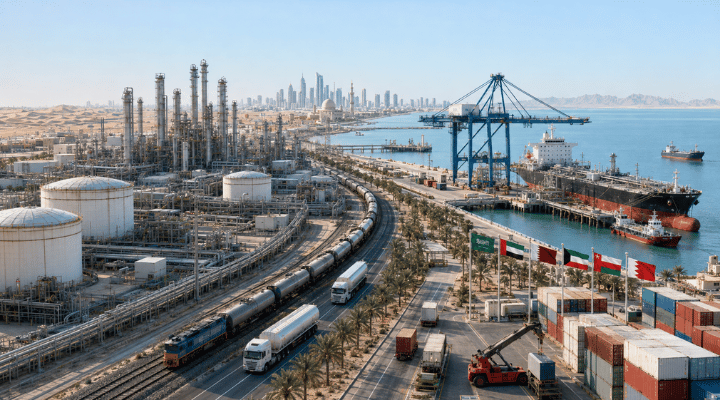
For decades, Gulf chemical producers built global strength on advantaged feedstock, world-scale assets and proximity to fast-growing Asian demand. In 2024, the Strait of Hormuz handled around 20 million barrels per day of oil flows, equal to about 20% of global petroleum liquids consumption according to the U.S. Energy Information Administration. The corridor is also critical to the movement of energy products, chemical feedstocks, fertilizers and other industrial cargo serving global markets.
But scale alone no longer guarantees resilience. Growing geopolitical uncertainty has made resilient execution as important to customers as price and product quality. For Gulf chemical producers, moving beyond a production-led advantage and building supply chain capabilities help protect reliability when operating conditions become unpredictable.
Why 2026 Changes the Resilience Equation
The events of 2026 exposed how dependent Gulf chemical exports remain on a handful of critical trade corridors. Instead of following established shipping patterns, producers increasingly had to evaluate alternative routes, carriers, ports, and border crossings while balancing cost, service, and delivery commitments.
For chemical supply chains, rerouting is rarely simple. Many products require specialized tanks, dangerous-goods compliance, temperature controls, carrier approvals, and port-specific handling. Whether using a UAE gateway outside the Strait, a Saudi Red Sea port, or another regional route, every alternative must be assessed for product compatibility, regulatory requirements, equipment availability, and total landed cost.
From Port Dependency to Route Optionality
Among these trade-offs, port dependency stands out as one of the most visible vulnerabilities for Gulf exporters. Many production clusters are closely tied to nearby export gateways, which creates efficiency in stable periods but limits flexibility during disruption. Supply chain leaders can address this by mapping every critical product lane against realistic alternatives.
For a polymer shipment, that might mean a primary port, a secondary port within the region and a cross-border trucking option held as backup, each one mapped and pre-cleared before it's ever needed, rather than a longer list of modes that have never been tested.
Route optionality does not mean duplicating every route at any cost. It means knowing which lanes justify pre-approved alternatives because customer impact, product criticality or margin exposure is high. For polyethylene, polypropylene, methanol or specialty chemicals, a delay can affect converter schedules, downstream inventory and contract performance.
Supply chain leaders therefore classify lanes by risk and value, then decide where to hold buffer inventory, secure alternative carrier capacity or pre-clear documentation for rerouting. Not every lane needs a pre-cleared alternative, the ones that do are the ones where a delay reaches the customer directly.
Exception Management: Turning Visibility into Action
As visibility alone doesn't solve the problem, it only shows the problem faster. Many enterprises can track shipments, but fewer can manage exceptions with clear priorities, ownership and escalation rules. Chemical logistics needs exception management that distinguishes between a minor delay, a documentation risk, a port closure, a dangerous goods rejection and a customer-critical failure. Each exception should trigger a defined playbook: who decides, what alternatives are available, what cost threshold applies and how customers are informed.
Digital supply chain platforms become commercially relevant at this point: route risk alerts, vessel status, port congestion, customs updates, carrier performance and inventory positions should feed into one operating view. The goal is not to overwhelm teams with dashboards; it is to reduce decision latency. A delayed shipment of commodity resin may require a different response from a late delivery of a hazardous intermediate tied to a customer shutdown. Managed well, this kind of exception discipline protects revenue, service and customer trust in equal measure.
Cost Control Without Sacrificing Service
Resilient supply chains control cost better because they avoid panic buying, last-minute premium freight, demurrage, detention and contract penalties. Resilience is often misunderstood as expensive redundancy, but the financial case improves when it is tied to lane segmentation. Not every product needs the same service level, and not every customer requires the same contingency plan.
Supply chain leaders should build cost-to-serve models that include disruption scenarios. These models should compare the cost of holding inventory near demand, booking backup capacity, using alternate ports or accepting longer transit times. The strongest producers will not choose the cheapest route by default; they will choose the route that best balances service promise, risk exposure and margin protection. That shift turns logistics from a cost centre into a commercial differentiator. But that balance is not one logistics can strike on its own.
Execution Governance for a Volatile Decade
Route decisions cannot sit only inside logistics teams; they need executive sponsorship across sales, manufacturing, procurement, finance, risk and customer service. Sales must understand which promises are realistic under disruption. Manufacturing must align production schedules with export constraints. Procurement must secure carriers and service providers with contingency clauses. Finance must approve cost thresholds before urgent decisions are needed. Customer service must communicate proactively when allocations or delivery windows change.
Governance also requires metrics beyond on-time delivery. Producers should track route concentration, percentage of volume with validated alternatives, average exception resolution time, demurrage exposure, customer-critical delay rate and recovery time after disruption. These indicators show whether resilience is improving or whether the enterprise is simply reacting faster to the same structural weaknesses. That distinction is the real test as the industry moves into a more volatile decade.
Conclusion: Resilience as the Next Export Advantage
As global trade becomes more unpredictable, the competitive advantage for Gulf chemical producers will increasingly lie in how effectively they execute, not just how efficiently they manufacture. Organizations that embed resilience into everyday operations through stronger route governance, faster decision-making, and coordinated execution will be better prepared to navigate disruption without compromising quality or profitability.
The challenge for supply chain leaders ahead is not to eliminate uncertainty, but to build supply chains that can adapt to it. Those that make resilience a core operating discipline today will be best positioned to sustain growth in an increasingly volatile environment.
Building a More Resilient Chemical Export Network with 3SC
Building this capability requires planning, risk intelligence and logistics execution to operate within one decision environment. 3SC’s AI-powered Digital Control Tower connects shipment visibility, route-risk intelligence, inventory exposure, multimodal alternatives and exception workflows. This helps chemical producers identify affected orders and customers, evaluate viable responses, coordinate decisions across functions and act before disruption becomes a service or revenue failure.