European chemical companies are facing sustained margin pressure from high costs, uneven demand, and underutilised capacity. This blog explores how smarter supply chain design can help by segmenting products, redesigning networks, optimizing inventory, connecting planning with execution, and evaluating the true cost of logistics, sourcing, compliance, and risk across the end-to-end supply chain.
Key Takeaways
- Segment supply chains by product value, demand variability, and handling requirements instead of applying one operating model across the portfolio.
- Redesign distribution networks around current customer demand and total landed cost, rather than legacy routes and warehouse structures.
- Classify inventory by purpose to protect service levels while reducing excess stock and working-capital pressure.
- Connect planning with daily execution so teams can assess cost, service, and margin before responding to disruptions.
- Measure compliance, logistics partners, and sourcing decisions across the complete journey to uncover the true cost of supply.
European chemical manufacturers are being asked to protect margins in a market where many of the largest cost pressures sit outside their control. Energy remains expensive, global competition is intensifying, demand is uneven, and customers continue to expect reliable supply.
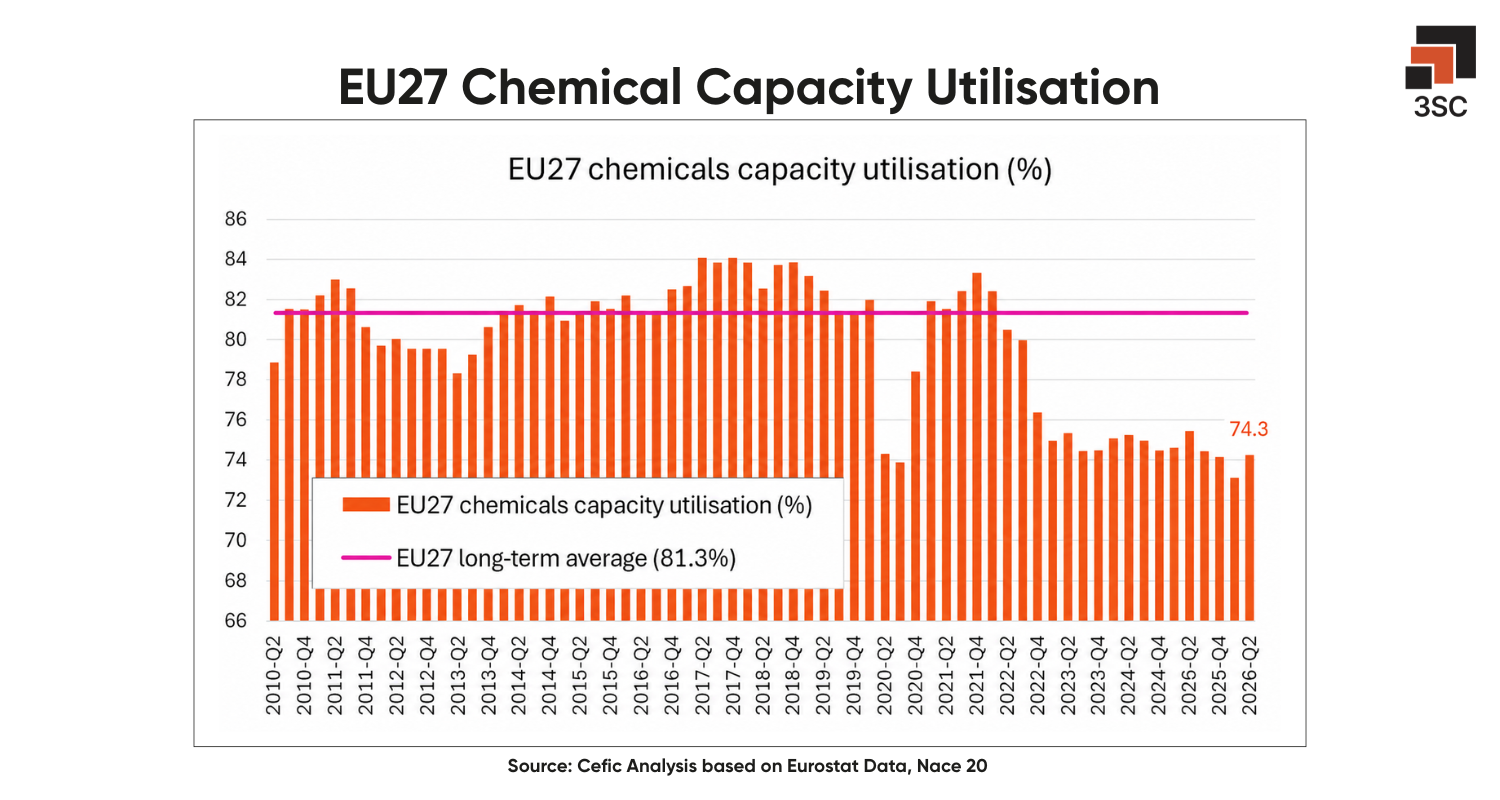
The pressure is visible in plant performance. Industry data shows that EU chemical capacity utilisation was around 74% in the first quarter of 2026, remaining well below its long-term average. This means many producers are carrying the cost of assets, labour, and infrastructure without using their available capacity fully.
Under these conditions, small supply chain inefficiencies become harder to absorb. Excess inventory, urgent transport, poor production sequencing, unnecessary handling, and weak coordination between partners can quickly turn a profitable order into a marginal one.
Consider a chemical producer supplying industrial customers across Germany, France, Italy, Poland, and the Benelux region. Sales remain stable, yet profitability keeps slipping. Management negotiates lower freight rates and pushes suppliers for better terms, but the improvements are temporary.
The deeper problem is the design of the supply chain itself.
Why A Single Supply Chain Model Cannot Serve Every Chemical Product
The initial review shows that specialty, regulated, and low-margin industrial chemicals are often planned and distributed through the same supply chain model. While this may simplify operations, it does not account for differences in demand, margins, handling requirements, and logistics costs.
For Example:
- Specialty products with uncertain demand may require inventory to be positioned closer to customers to protect service levels.
- Low-margin commodities need a different approach. The priority is often to improve production cycles, consolidate movements, and use lower-cost transportation.
- Hazardous and regulated products add another layer of complexity, requiring specialised storage, compliant transportation, and carefully planned routes.
Chemical companies should therefore segment products by margin, demand variability, and handling requirements, and design inventory, transport, and fulfilment strategies around each segment.
This way, each segment will be operated under different logistics rules, providing separate policies for inventory management and customer fulfilment by establishing a realistic understanding of expenses, indicating where the speed of the processes can be justified by expenses. Having segmented the portfolio, the firm should evaluate if the physical distribution network is suitable to meet the needs of each segment.
Is Your Distribution Network Still Fit for Today’s Market?
Chemical distribution networks often evolve through a complex history of acquisitions, regional considerations, and legacy contracts. Consequently, chemical warehouses emerge as convenient locations, even when their need is not clear.
When the company audits its distribution chain for each major product family, it discovers that some products change hands multiple times before reaching the final customer. This results in higher transportation costs, inventory costs, storage expenses, paperwork, and demurrage, not to mention the increased risk of damage, errors, and delays.
Therefore, the company should consider its distribution network design from the perspective of total landed cost and not only comparing the costs of warehouse leases and freight bills. It should consolidate required distribution operations, direct selected products to key customers, eliminate some storage costs, and get closer to major buyers, thus lightening supply chains and reducing inventories at all points.
The organisation should also make sure that every distribution centre, warehouse, and transportation leg has a clear economic justification so that none of them exist for the sole reason of carrying inventory that is not needed.
But should the company’s entire distribution network truly focus on what the market needs, or is there a danger of holding on to working capital too tightly?
How Much Inventory is Protecting Margin and How Much is Hiding Cost?
Chemical companies have numerous justifications for holding inventory. Long production runs, high changeover costs, import restrictions, and specific customer requirements are a few examples of why companies may need to hold inventory in addition to their expected requirements.
The danger is that it becomes the answer to any supply chain uncertainty. The company has plenty of inventory, but certain markets are still experiencing shortages. At the same time, one warehouse holds months’ worth of supply of a slow-selling product, while another faces an urgent need for replenishment.
The planning team analyses the inventory to identify general categories:
- Cycle stock to meet demand,
- Safety stock to address forecast uncertainty,
- Strategic stock to cover particular risks,
- Excess inventory with no defined purpose.
For some products, the planning team delays further processing until it receives more information on customer requirements. It allows the same raw material to serve multiple markets and reduces the risk of holding finished goods in warehouses for months.
Similarly, inventory targets can be set in relation to profit, supplier reliability, production constraints, service requirements, and other factors. In this way, working capital is reduced, while the protection provided by inventories is maintained.
The effectiveness of inventory management policies is significantly increased when combined with the ability to quickly adapt to changing conditions.
Where Planning Breakdowns Turn into Margin Loss
A monthly supply plan can become outdated after one delayed shipment, a production outage, or an unexpected customer order. The financial impact depends on how quickly the business understands the issue and agrees on a response.
In earlier processes, each function handled a different part of the problem. Sales focused on the customer, production on capacity, and logistics on transport. Finance often saw the margin impact after the decision had already been made.
Therefore, Chemical companies need to implement a more connected planning and execution process, so when an exception appears, teams compare practical options before committing additional cost. They may:
- Reallocate stock from another market
- Adjust the production sequence
- Use an approved substitute
- Split the order into two deliveries
- Negotiate a revised delivery date
Premium freight remains available, but it is approved only when the order value and customer impact justify the expense. Alerts are also simplified so planners see issues that require a decision, together with the likely effects on cost, service, and inventory. Each major exception has an owner and an escalation path.
This allows margin to be protected while the decision is still open, rather than explained after the shipment has moved. The same discipline should shape compliance, carbon, and sourcing decisions.
How Compliance, Carbon, and Risk Change the True Cost of Supply
Chemical logistics can become expensive when product classification, documentation, storage conditions, or carrier capability are addressed too late. A shipment held at a border or rejected by a warehouse can create handling costs, customer delays, and emergency transport.
The company, thus, brings compliance into network and route design. Warehouses are checked for product suitability, carriers are assessed for the right equipment and approvals, and documentation responsibilities are defined across every handover.
Carbon and supply risk are also included in sourcing decisions. A distant supplier may offer a lower price per tonne, but the complete flow may require longer lead times, more inventory, additional transport, and greater disruption protection.
A regional supplier may charge more while improving responsiveness and reducing working capital. Dual sourcing may also be worthwhile when a material is critical to production.
By looking at the full economic impact, businesses can distinguish between a low purchase price and a genuinely lower supply cost. This broader view becomes easier to manage when logistics partners are measured against shared outcomes.
Why End-to-End Logistics Performance Matters More Than Individual Freight Rates
A chemical shipment may involve an ocean carrier, road transporter, warehouse, customs broker, and local delivery partner. Each provider can meet its own target, and the final delivery can still fail.
A container may reach the port on time but has to wait because the warehouse has no capacity. A carrier may arrive as scheduled but without the correct equipment. The cargo may move smoothly while incomplete documentation delays its release.
To manage these uncertainties more effectively, chemical companies should measure end-to-end logistics performance using a focused set of meaningful indicators.
- Delivery reliability
- Dwell time and demurrage
- Documentation accuracy
- Emergency freight
- Total cost-to-serve by product and customer
These indicators help identify where delays, additional costs, and service failures are actually being created across the journey. They also make it easier to determine which issues require better coordination between internal teams and logistics partners.
Partners should receive early visibility into demand, product requirements, and priority orders so they can plan capacity, equipment, and routes more effectively. Freight rates should then be evaluated alongside reliability, safety, responsiveness, and total cost-to-serve, making logistics procurement part of the broader margin strategy.
Conclusion: Margin Protection Starts with Supply Chain Design
European chemical companies cannot dictate global oil prices, eliminate all trade restrictions, or prevent all supply disruptions. However, they can control the costs and responsibilities associated with each supply chain transaction when these forces come into conflict.
A supply chain that is designed to deliver the highest value to each product category will appropriately balance service models, inventory, planning, and execution functions while also incorporating compliance and risk elements prior to any shipment. In addition, it will produce actionable, granular insights that empower leaders to act on high-impact customers, products, and routes to maximize profits.
Moreover, the chemical companies that will be most successful at protecting their margins will not focus exclusively on rate negotiations. Instead, they will seek to optimize costs across all nodes in the supply chain network, including suppliers, plants, warehouses, logistics partners, and customers.
For the European chemical industry, where supply chain design is quickly evolving into a core commercial competency, the companies that adopt this approach will be best positioned to both protect their margins and maintain high levels of service in order to remain competitive within the region.
Strengthen Margin Performance Across the Chemical Supply Chain with 3SC
3SC helps chemical companies redesign supply chains around product economics, customer service, inventory, risk, and total cost-to-serve. By connecting planning with real-time execution, teams can identify margin leakage earlier and make better decisions across sourcing, production, inventory, and logistics.
Build a supply chain that responds faster, uses working capital more effectively, and protects profitability across every movement.