Demand sensing and traditional forecasting both help businesses predict demand, but they serve different planning needs. Traditional forecasting uses historical data to support long-term decisions like production, procurement, and budgeting. Demand sensing uses real-time signals to adjust short-term plans. Together, they help supply chains improve accuracy, reduce stockouts, and respond faster to market changes.
Key Takeaways
- Traditional forecasting gives businesses a long-term demand view for planning production, procurement, inventory, and budgets.
- Demand sensing uses real-time signals to capture near-term demand shifts before they become operational problems.
- Forecasting is best for strategic planning, while demand sensing is best for short-term replenishment and execution decisions.
- Demand sensing does not replace forecasting; it strengthens the plan by correcting it as market conditions change.
- The real supply chain advantage comes from connecting demand signals to faster, more confident action.
Every supply chain has faced this moment.
The monthly forecast says demand will remain steady. Production has already been planned. Inventory has been positioned. Procurement has placed orders based on the approved plan. Then, within a few days, the market moves differently. A promotion performs better than expected. A competitor runs out of stock. Weather changes buying behaviour. An online trend pushes sudden demand for one product while another slows down.
By the time teams notice the shift, the business is already reacting. Some locations are short. Others are carrying excess stock. Planners are checking reports, operations teams are chasing availability, and logistics teams are trying to move inventory faster than the plan originally required.
This is where the conversation around demand sensing vs traditional forecasting becomes important. The real question is not which one is better. The better question is: how do you use both to make supply chain decisions faster, sharper, and closer to what the market is actually doing?
What is Traditional Demand Forecasting?
Traditional demand forecasting is the long-standing planning method used to estimate future demand based on past sales, seasonal trends, market patterns, promotions, and business assumptions.
It helps answer questions such as:
Planning Question | Why It Matters |
|---|---|
How much demand should we expect next quarter? | To plan production, procurement, and capacity. |
Which products need higher inventory before peak season? | To reduce stockouts during predictable demand spikes. |
What supplier commitments should we make? | To secure materials and manage lead times. |
What revenue should the business plan for? | To align sales, finance, and operations. |
In simple terms, traditional forecasting gives the business a structured view of the future. It is especially useful when demand patterns are stable, seasonal, or shaped by known events.
For example, if a beverage company knows that demand rises every summer, historical sales can help estimate how much production should increase before the season begins. If a retailer runs an annual festive campaign, past promotional performance can guide stock planning months in advance.
But the strength of forecasting is also its limitation. It depends heavily on what has already happened. When market behaviour changes suddenly, the forecast can lag behind reality.
That does not make forecasting outdated. It simply means forecasting is not designed to manage every short-term disruption by itself.
What is Demand Sensing?
Demand sensing is a more real-time approach to demand planning. Instead of relying mainly on historical data, it uses current demand signals to understand what is happening now and what may happen in the near term.
These signals can include:
Demand Signal | What It Can Reveal |
|---|---|
Point-of-Sale Data | What customers are buying right now. |
Website or App Traffic | Early signs of purchase interest. |
Open Orders | Immediate demand pressure. |
Weather Data | Category-level demand shifts. |
Social Media Trends | Emerging demand spikes. |
Competitor Stockouts or Pricing | Possible demand movement toward your products. |
Inventory and Shipment Status | Whether supply can respond to demand. |
Demand sensing typically works over a short horizon: days to a few weeks. It helps businesses adjust replenishment, inventory allocation, production priorities, and distribution decisions before small demand changes become larger service issues.
Imagine a personal care brand sees a sudden spike in online searches and sales for sunscreen after an unexpected heatwave. A traditional forecast may not capture that change until the next planning cycle. Demand sensing can detect the shift sooner and help teams move stock to the right locations faster.
That is the real value of demand sensing. It does not replace the plan. It updates the near-term picture when the market starts behaving differently from the plan.
Demand Sensing vs Traditional Forecasting: Key Differences
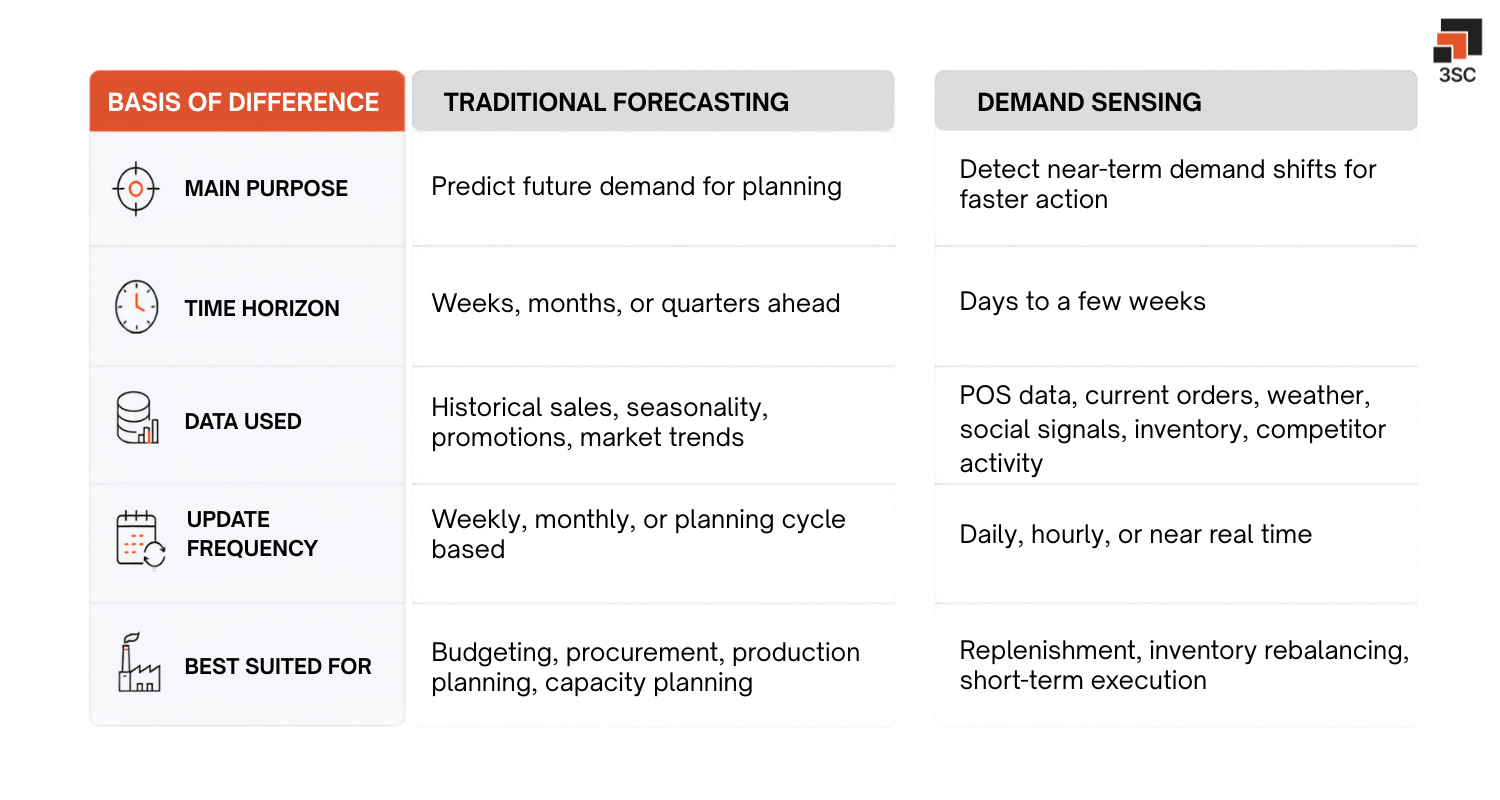
Traditional forecasting and demand sensing both aim to improve demand planning, but they work in different ways. One provides a longer-term view. The other sharpens short-term decisions.
Basis of Difference | Traditional Demand Forecasting | Demand Sensing |
|---|---|---|
Main Purpose | Predict future demand for planning. | Detect near-term demand shifts for faster action. |
Time Horizon | Weeks, months, or quarters ahead. | Days to a few weeks. |
Data Used | Historical sales, seasonality, promotions, and market trends. | POS data, current orders, weather, social signals, inventory, and competitor activity. |
Update Frequency | Weekly, monthly, or planning cycle-based. | Daily, hourly, or near real time. |
Best Suited For | Budgeting, procurement, production planning, and capacity planning. | Replenishment, inventory rebalancing, and short-term execution. |
Strength | Provides structure and alignment for long-range planning. | Improves responsiveness to changing market conditions. |
Limitation | Can be slow to react to sudden changes. | Less useful for long-term strategic planning. |
Business Value | Helps teams plan resources and commitments. | Helps teams act before demand gaps become operational problems. |
The distinction is simple: forecasting gives direction; demand sensing helps with correction.
A forecast may say what the business expects. Demand sensing helps reveal whether reality is still following that expectation.
When Should Businesses Use Forecasting, Demand Sensing, or Both?
The right approach depends on the planning horizon, the speed of the decision, and the level of uncertainty involved.
- Traditional forecasting is most valuable when decisions require a longer-term view and cannot be changed frequently. Investments in capacity, supplier contracts, workforce requirements, production resources, and distribution networks need a reasonably stable demand outlook. Forecasting provides the baseline required to align financial, commercial, and operational plans.
- Demand sensing becomes more relevant closer to execution, when recent market signals can improve the next decision. Changes in customer orders, point-of-sale activity, distributor movement, inventory positions, promotions, weather, or channel demand may reveal shifts that historical forecasts have not yet captured.
Demand sensing should not replace the long-term plan. Short-term signals can be volatile, so businesses need clear rules on which changes require action.
Using both creates a stronger planning model. Forecasting provides direction, while demand sensing helps teams adjust execution without losing alignment with the broader plan. Planning maturity comes from connecting long-term intent with short-term response.
Conclusion: The Future is Not Forecasting vs Sensing
Demand sensing and traditional forecasting are not competing ideas. They are different layers of the same planning capability.
Traditional forecasting helps businesses prepare for what is likely to happen. Demand sensing helps them respond to what is already changing. One builds the long-range view. The other protects near-term execution.
For supply chain leaders, the real opportunity is to stop treating demand planning as a static exercise. The market does not wait for the next planning cycle. Customers do not buy according to monthly review calendars. Disruptions do not arrive only after teams are ready.
The businesses that perform better will be those that can sense change early, understand its impact, and act before the gap becomes visible to the customer.
Because in modern supply chains, the advantage is not just knowing demand better. It is responding to demand faster, with greater confidence and control.
Build a More Responsive Demand Planning Engine
3SC helps enterprises bring forecasting, demand sensing, inventory visibility, and execution intelligence into one connected planning ecosystem. By turning changing demand signals into faster, more coordinated decisions, 3SC enables supply chain teams to improve availability, reduce planning uncertainty, and respond to market shifts with greater speed and confidence.
Learn how Demand AI, Supply Chain Analytics, and the Supply Chain Control Tower help enterprises make faster, data-driven planning decisions.