Key Takeaways
- Early demand forecasting boosts agility and reduces inventory risks.
- Forecasting new products is difficult due to limited data and market unpredictability.
- Emotional and brand factors must be considered alongside analytics.
- Accurate forecasts support smarter budgeting and resource planning.
- Methods like trial runs, expert input, and analogies improve prediction accuracy.
- AI-driven forecasting enables real-time insights and scalable decision-making.
Forecasting demand early in the product lifecycle allows supply chains to be more agile, responding quickly to real-time market feedback. This agility helps avoid costly stockouts or excess inventory, especially during critical launch phases. It also ensures smarter resource allocation across sourcing, production, and logistics, boosting both responsiveness and scalability.
In 1985, Coca-Cola released a new beverage that was predicted to take over the market: New Coke. The company had been losing market share to competitors and carefully formulated a new beverage according to the feedback from focus groups and blind taste tests. The data looked promising. Forecasts predicted strong demand, and the company confidently moved ahead with the product launch. But when the product hit the shelves, consumers hated New Coke, and within three months the product was pulled from shelves.
Even though taste tests predicted huge demand for a new, sweeter version of the popular drink, consumers didn’t want to buy it because they had a strong attachment to what Coke was supposed to taste like.
But why did this happen? Because while the data reflected taste preferences, it failed to capture the emotional attachment consumers had to the original Coke. The forecast missed the deeper brand loyalty factor something difficult to quantify but critical to demand planning.
This example underscores a vital lesson: demand forecasting isn’t just about historical data and statistical models. It’s also about understanding the market context, customer sentiment, and behavioural triggers that influence purchasing decisions.
For modern businesses, especially in industries like CPG, retail, and wholesale, forecasting demand for new products is one of the most complex parts of planning. Done right, it helps companies align production, inventory, and distribution with actual market needs reducing overstock, avoiding stockouts, and improving customer satisfaction. As for any supply chain to function efficiently, it must begin with a clear understanding of current and future demand. In today’s fast-changing economic environment, where consumer preferences shift quickly and market conditions are often unpredictable, accurate demand forecasting has become essential.
Why is Demand Forecasting for New Products Important?
Inventory is a critical asset, and even minor mismanagement can disrupt supply chain efficiency and inflate holding costs. And when it comes to supply chain operations, inventory-related costs require precise control. Demand forecasting becomes essential for planning optimal stock levels, enabling a more streamlined and efficient production process.
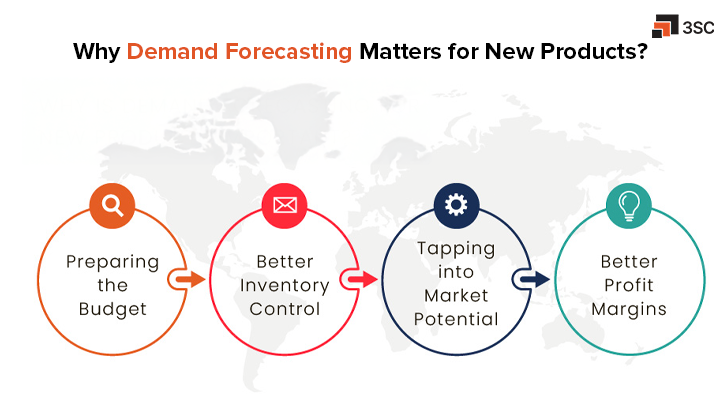
1. Preparing the Budget
When introducing a new product, a well-defined budget is essential for planning production, inventory, and marketing activities in line with expected demand. It helps allocate resources efficiently, avoid overspending, and ensure you're financially prepared for different demand scenarios. With a clear budget understanding, businesses can make more informed decisions about pricing, supply chain planning, and go-to-market strategies, ultimately improving the chances of a successful launch.
2. Better Inventory Control
New product launches often carry uncertainty, and poor inventory planning can quickly lead to overstock or missed sales. Demand forecasting enables better visibility into expected customer needs, allowing businesses to maintain optimal inventory levels. This ensures timely order fulfilment, prevents supply shortages during peak demand, and reduces excess inventory that can tie up capital. Effective inventory control, backed by accurate forecasting, leads to smoother operations, stronger supplier relationships, and a more dependable customer experience.
3. Tapping into Market Potential
Market opportunities are no longer predictable; they appear fast and fade faster. To capitalize on these brief windows, businesses need demand forecasting to anticipate what customers will want and when. Factors like seasonality, emerging market trends, promotional pricing, and even social media buzz can rapidly shift buying behaviour. Dynamic pricing strategies such as flash sales rely on this foresight to succeed.
With accurate forecasts, companies can stock inventory in advance, align marketing campaigns with demand peaks, and move quickly when trends for the new product emerge. This not only drives higher conversion rates but also builds brand momentum and keeps the business ahead of the curve.
4. Better Profit Margins
Strong profit margins are the foundation of sustainable business growth. Demand forecasting helps improve them by enabling smarter, data-driven decisions on pricing, production, and inventory. When companies align supply with actual market demand, they reduce waste, avoid markdowns, and improve operational efficiency. With a clear view of anticipated demand, businesses can stay ahead of market shifts and consumer expectations. It helps align product readiness and promotional efforts, leading to stronger brand recognition, deeper customer trust, and increased loyalty. Ultimately, it transforms data into strategic advantage, fuelling profitability and reinforcing long-term brand equity.
What are the Methods of Demand Forecasting for New Products?
Demand forecasting for new products involves a mix of analytical and research-based approaches designed to estimate future sales in the absence of historical data. Since new products haven’t yet entered the market, companies rely on alternative data sources, market comparisons, and consumer behaviour analysis to gauge potential demand.
The goal is to make informed decisions about production, pricing, inventory, and distribution, ensuring that the new offering aligns with customer expectations and market readiness.
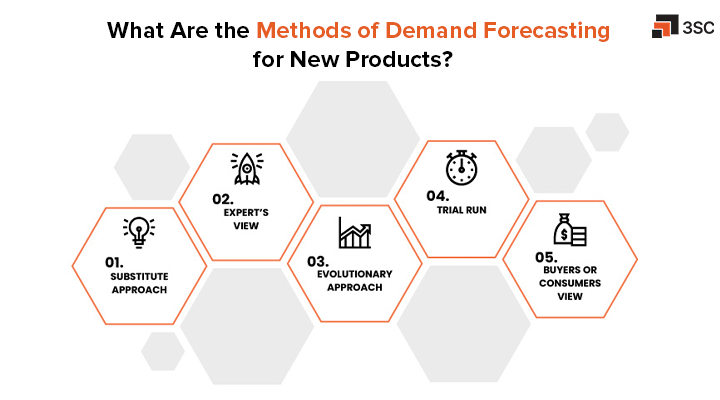
Below are some widely used methods that help businesses forecast demand for new products effectively.
1. Substitute Approach
This method runs on the assumption that the introduction of a new product in place of an existing one will give the organization some workable marketing insights. It generally includes opinion analysis or surveys based on expected demand patterns, which helps the production team gather constructive feedback for planning and refinement.
2. Evolutionary Approach
This method assumes that the new product represents a natural progression or enhancement of an existing offering. Rather than starting from scratch, it builds on the performance patterns of previous products, allowing the new launch to follow a similar life cycle trajectory. In this approach, historical sales data of the predecessor product serves as a foundational baseline, guiding expectations and shaping more informed forecasts for the successor.
3. Buyers or Consumers view
This action plan accounts for an organization’s loyal user base as its early bird consumers for the new product and relies on their first-impression view. A company runs predictive analysis on these first reviews, feedback and reactions to set demand forecasts for a fully-fledged market launch.
4. Expert’s View
This approach relies on the insights of experts who possess a deep understanding of market dynamics, customer behaviour, and competitive landscapes. Their experience and judgment help businesses anticipate demand for new products, especially in the absence of historical data. An expert’s perspective often serves as a guiding reference, enabling organizations to shape realistic forecasts and build confidence in their go-to-market strategy.
5. Trial Run
As the name suggests, this method applies a trial run for the new product in certain selected retail areas for a specified period. Its response sets the base for forecasting the sales of the latest development.
Why Demand Forecasting for New Products is Difficult? - Top Challenges
For an organization to start with its demand forecasting for new products, there are quite a few challenges to begin with.
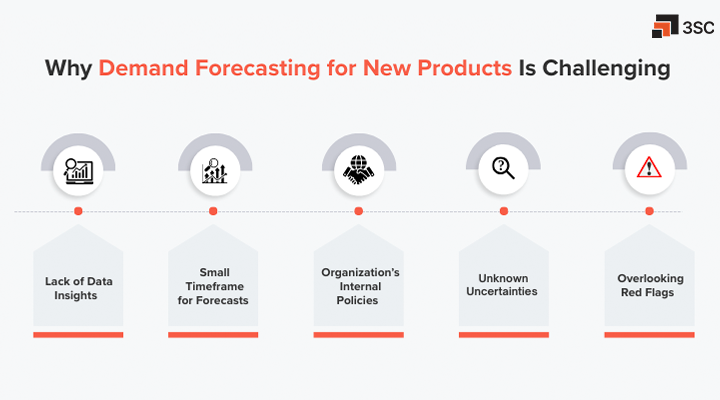
1. Lack of Data Insights
Any business initiating a novel project requires historical data to chart its course. However, for a new product launch, relevant internal data is often unavailable, especially when the product is entirely new, from ideation to development. In such cases, companies can gather supporting insights from third-party data sources, such as industry reports, market research studies, or consumer trend analyses. These external data points help fill knowledge gaps, offering a broader perspective on expected demand patterns and competitive benchmarks. If the new offering is a slight improvement of an existing product, internal sales trends can also serve as a starting reference.
2. Small Timeframe for Forecasts
With stiff competition in retail, companies are always in dual mode to edge out their competitors. This often pushes organizations to design a new launch without accurate information leading to demand forecasting full of errors. Such pursuits of excellence in shorter duration are generally lacking in fruitful results.
3. Organization’s Internal Policies
Internal misalignment across departments, rigid approval processes, or siloed decision-making can make forecasting for new products more complex. When different teams, such as marketing, sales, and supply chain, aren’t working with a unified strategy or shared data, forecasts can become skewed or delayed. As a result, internal priorities may take precedence over market realities, reducing the overall accuracy and effectiveness of the forecasting process.
4. Unknown Uncertainties
Predicting how consumers and the market will respond to a new product is inherently challenging. Even with advanced data analytics and predictive models, there are factors that remain unpredictable until the product is launched. Marketing campaigns may fail to gain traction, the intended target audience may not respond as expected, or competitor actions could shift consumer interest suddenly. These unforeseen variables can undermine even the most well-structured forecasts. Such uncertainties highlight the limitations of planning and the importance of building flexibility into forecasting and launch strategies.
5. Overlooking Red Flags
One of the most common pitfalls in new product forecasting is when organizations ignore warning signs revealed in early data or analysis. In some cases, leadership may push forward with a launch based on internal pressure, overconfidence, or sunk cost bias, despite clear indications of weak demand potential. This can lead to poorly timed launches, misaligned go-to-market strategies, or products that fail to meet evolving sustainability expectations. Additionally, complexities such as supply chain limitations, shifting regulatory standards, or untested logistics models often go unaddressed. When these red flags are overlooked, businesses risk not only financial loss but also reputational damage and long-term operational inefficiencies.
To avoid these costly pitfalls, businesses need more than just data, they need intelligent foresight. A robust demand forecasting solution that centralizes business operations, aligns internal stakeholders, and integrates real-time analytics ensures red flags aren’t just detected, they’re addressed collaboratively and proactively. With AI and research-backed insights at the core, organizations can transform uncertainty into clarity, align launches with real market demand, and build a supply chain that’s not only responsive, but resilient.
Solutions for Demand Forecasting of New Products
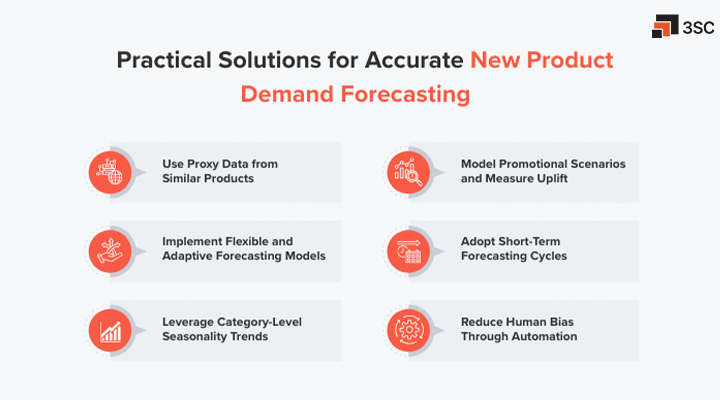
1. Use Proxy Data from Similar Products
Forecast based on performance of similar SKUs, product categories, or historical launches. Combine with market research, customer surveys, and pre-order data to strengthen early estimates.
2. Implement Flexible and Adaptive Forecasting Models
Use models that allow frequent updates and scenario planning. Incorporate AI or machine learning to detect early sales patterns and adjust forecasts in real time.
3. Leverage Category-Level Seasonality Trends
Apply seasonal and trend data from related product lines to new launches. Benchmark against past seasonal launches and align with macro-industry movements.
4. Model Promotional Scenarios and Measure Uplift
Plan for different promotional strategies using comparative uplift data. Track campaign impact closely and test smaller campaigns first to forecast broader promotional demand.
5. Adopt Short-Term Forecasting Cycles
Use weekly or bi-weekly forecasting windows to stay responsive. Maintain agile inventory and replenishment strategies that allow quick adjustments as data comes in.
6. Reduce Human Bias Through Automation
Use demand planning software that blends historical data, AI, and collaborative inputs. Allow controlled overrides but anchor the process in system-driven forecasts.
Conclusion
Demand forecasting for new products sits at the intersection of strategy, intuition, and data science. While the tools and methodologies available today have made forecasting more precise, the real challenge lies in interpreting signals beyond the obvious, reading market sentiment, adapting to evolving consumer behaviour, and accounting for operational realities.
Success does not come from eliminating uncertainty but from building enough foresight to navigate it. Companies that embrace a balanced approach by combining predictive models with qualitative insights, trial strategies, and internal alignment are more likely to launch products that not only meet demand but influence it.
In a world where speed to market is critical but missteps are expensive, mastering new product forecasting is no longer just a supply chain task. It is a core business capability.
Power your growth with Intelligent Demand Forecasting
While forecasting demand for new products is complex, organizations can unlock greater operational efficiency, boost production readiness, and exceed customer expectations with 3SC’s Demand Forecasting solutions. Our advanced data analytics-based SaaS analyses demand-driving variables using AI and machine learning to provide risk-adjusted projections, leading to optimized end-to-end supply chain operations.