Highlights
- Planning maturity is no longer defined by process discipline, but by decision velocity.
- When volatility is continuous, calendar driven planning is no longer enough.
- Decision Centric Planning shifts the focus from completing cycles to enabling high quality, timely decisions.
- Signals, not schedules, should determine when action is required.
- Agility is not about reacting faster, it is about reducing friction between data, alignment, and execution.
- The strongest supply chains do not just plan well, they decide well, at the right moment.
Supply chains today are not failing because they lack structure. In fact, most organizations have well-defined Sales and Operations Planning (S&OP) cycles, governance forums, and escalation paths designed to bring discipline, cross-functional alignment, and predictability to planning. Yet the reality inside many organizations tells a different story. Research from Gartner shows that more than one-third of organizations spend over 30% of their time responding to supply chain disruptions rather than executing planned operations. The real tension lies elsewhere: the speed of change has outpaced the speed of structured decision-making.
Demand shifts mid-cycle. Supply constraints emerge unexpectedly. Costs fluctuate within weeks, not quarters. Yet many organizations still rely on planning cadences originally designed for more stable environments. When disruption happens between formal reviews, teams react through emails, urgent calls, and exception meetings, creating effort without clarity and activity without architectural alignment.
To address these limitations, many organizations have progressed from traditional S&OP toward Integrated Business Planning (IBP). IBP elevates planning by tightly connecting financial, commercial, and operational objectives, creating enterprise-wide alignment and stronger strategic integration. It remains the foundation of mature planning organizations.
However, as volatility becomes continuous rather than episodic, organizations increasingly require the ability to respond dynamically between formal planning cycles. This is where Decision-Centric Planning (DCP) adds value, not as a replacement for IBP, but as a capability within it.
What is Decision Centric Planning?
Decision-Centric Planning is a modern approach that enables organizations to sense change, evaluate impact, and respond in real time. Rather than relying solely on fixed planning cycles, it continuously monitors demand, supply, and operational signals across the network. By embedding structured decision rules and scenario evaluation into the planning process, companies improve decision velocity without sacrificing alignment. The outcome is a more agile supply chain, one that not only withstands disruption but also identifies and captures opportunities as market conditions evolve.
Let’s break this further and understand
Reframing Planning: From Process Excellence to Decision Excellence
Traditional planning models were built around process optimization. The objective was to standardize workflows, align stakeholders, and create predictable governance. For years, this approach strengthened cross-functional coordination and reduced variability.
However, these models assume that decisions can wait for the next cycle. In today’s volatile environment, that assumption is increasingly unrealistic. Market conditions, supply variability, and demand shifts evolve too quickly to be contained within calendar-driven reviews.
Decision-Centric Planning helps introduces a different perspective. It reframes planning not as a series of meetings or structured outputs, but as a system designed to enable high-quality decisions. The ultimate measure of planning effectiveness, therefore, is not the completion of a cycle, but the quality and timeliness of the decisions it produces.
Identifying the Decisions That Matter
Instead of optimizing the sequence of planning steps, Decision-Centric Planning (DCP) focuses on the decisions that directly influence performance, such as:
- Allocation during constrained supply
- Capacity shifts across plants or regions
- Inventory positioning under demand uncertainty
- Policy overrides in response to disruptions
By clearly defining these decision categories, organizations can articulate the business rules, trade-offs, and performance thresholds that govern them. This clarity exposes where ambiguity exists and where delays originate.
When decisions become the focal point, planning stops being calendar-driven and becomes outcome-driven. The architecture must then evolve to support decisions when they are needed, not when the calendar dictates.
That shift naturally leads to a new operational model.
From Cycles to Signals: Building a Responsive Decision Framework
Once decisions are prioritized, the next challenge is determining when they should be initiated. Traditional planning relies heavily on fixed review cycles. Decision-Centric Planning relies on signals.
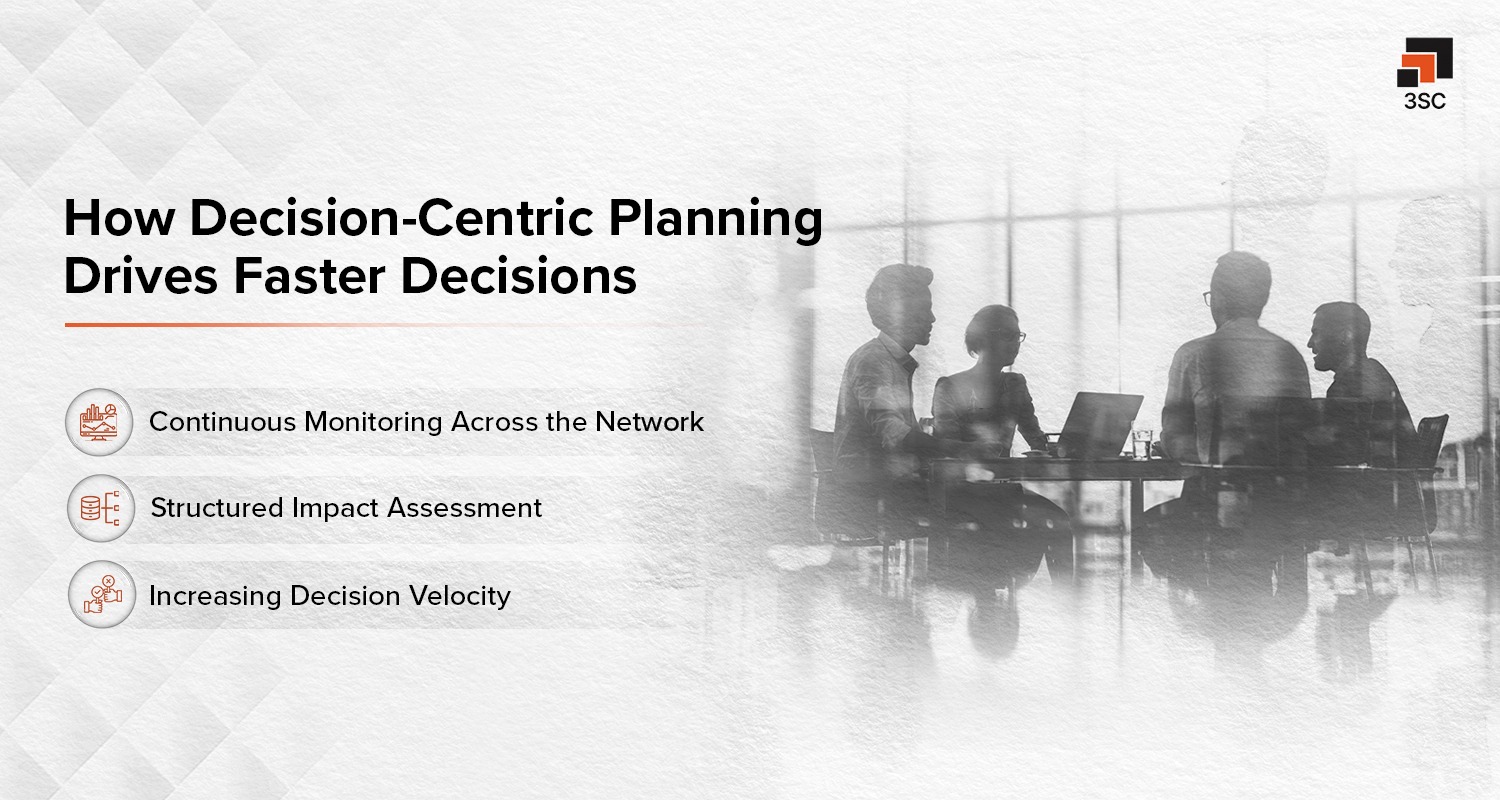
1. Continuous Monitoring Across the Network
A modern supply chain generates real-time data across demand, supply, logistics, and inventory nodes. DCP leverages this data to monitor meaningful changes as they occur. However, visibility alone does not create agility. The differentiator is structured interpretation.
2. Structured Impact Assessment
When a deviation is detected, the organization must quickly assess:
- Which decision category is affected
- How far the impact spreads across the network
- Which KPIs are at risk
This disciplined evaluation prevents two common pitfalls: overreacting to noise or underreacting to genuine threats. Instead of triggering a full replanning cycle for every fluctuation, responses are calibrated based on predefined thresholds.
3. Increasing Decision Velocity
With impact assessment embedded, the organization reduces the time between signal detection and aligned action. This is decision velocity.
Decision velocity is not about impulsive action. It reflects the removal of friction between data, analysis, stakeholder alignment, and execution. When business rules are predefined and scenarios can be evaluated quickly, teams move confidently rather than defensively.
Technology plays a crucial enabling role. Advanced planning platforms integrate data, automate event detection, simulate alternatives, and apply policy-based logic. Rather than relying on manual interpretation, decision-makers operate within a structured analytical framework.
With signal-driven responsiveness in place, the organization becomes more adaptive. The next question becomes: where should this transformation begin?
Starting Where Change Is Achievable
While the strategic ambition of DCP may suggest beginning at the executive level, this is often the most complex and resistant layer. Enterprise planning forums involve broad stakeholder groups, established governance routines, and significant financial trade-offs. Redesigning decision logic at this level first can slow momentum before tangible value is demonstrated.
A more pragmatic entry point lies closer to execution, where decisions are frequent and impact is immediate.
Why This Approach Works
Decisions such as allocation adjustments, production schedule changes, order prioritization, and inventory rebalancing occur daily and operate within shorter time horizons. Because they involve narrower stakeholder groups and faster feedback loops, they provide a manageable environment to embed structured decision rules, signal monitoring, and defined impact thresholds, without disrupting enterprise governance.
1. Impact and Faster Learning
Introducing decision-centric principles creates visible improvements quickly. Variability is addressed earlier, responses become structured rather than reactive, and escalation paths are clearer. Teams begin to rely on defined rules and data-driven evaluation instead of informal coordination.
The shorter learning cycle also simplifies change management. Business rules can be refined iteratively, thresholds adjusted based on experience, and governance strengthened through practice rather than mandate.
2. Scaling Upward
As decision-making becomes more consistent and impact-driven, the broader planning system benefits. Executive forums receive clearer, better-contextualized inputs instead of absorbing unresolved volatility. Discussions shift toward strategic trade-offs rather than corrective action.
This gradual progression transforms Decision-Centric Planning from a conceptual improvement into a practical evolution, one that strengthens the planning architecture without destabilizing it.
Conclusion: Redefining Planning Maturity
Decision-Centric Planning strengthens structured frameworks such as IBP by ensuring they remain responsive in a volatile environment. Processes continue to provide alignment and governance, but action is no longer limited to fixed cycles. Instead, decisions informed by real-time signals and business impact determine when intervention is required, allowing organizations to respond with precision.
As volatility becomes the norm rather than the exception, planning maturity is defined not only by discipline, but by adaptability. Organizations that anchor their architecture around critical decisions, supported by continuous monitoring and impact assessment, embed resilience into the system itself. In doing so, they move from reacting to change to navigating it with intent.
Ultimately, planning exists to drive business outcomes. When decisions are elevated to the centre of that architecture, planning becomes more aligned with its true purpose.
In a world defined by uncertainty, that alignment is not optional, it is strategic.