Key Takeaways
- Route disruption is now a quality risk, increasing temperature, documentation, and release-delay exposure.
- Cold-chain dependency is rising as sensitive therapies demand tighter time, temperature, and handling control.
- 2026 disruptions are breaking assumptions around stable lanes, lead times, capacity, and compliant handoffs.
- Visibility must shift from shipment tracking to real-time risk intelligence and decision support.
- Digital twins help test rerouting, packaging, inventory, and release risks before disruption hits.
Global pharmaceutical supply chains are being tested by a new operating reality: route instability, geopolitical disruption, port congestion, airfreight volatility, and rising compliance pressure are no longer exceptional events. They are becoming structural conditions.
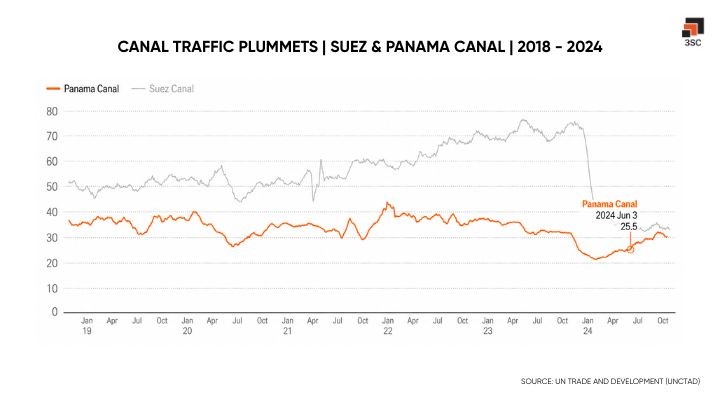
The Red Sea and Suez Canal disruption, The US-Israel-Iran war, showed how quickly a core global artery can lose reliability. UNCTAD reported that by mid-October 2024, average Suez Canal transits had fallen to 33 ships per day, around 57% below the previous peak and 55% lower than one year earlier. For pharma, that kind of shock is not only about freight rates or longer lead times. It directly affects temperature-controlled integrity, qualified-lane assumptions, market supply continuity, and regulatory confidence.
As the sector moves through 2026, the central lesson is clear: cold-chain resilience cannot depend on stable routes. It must be designed for instability.
Route Disruptions Expose Hidden Structural Weakness
Most pharma supply chains were built around validated operating assumptions: defined lanes, known transit windows, approved carriers, qualified packaging, predictable customs flows, and controlled handoffs. When routes change suddenly, those assumptions weaken together.
A shipment rerouted around a conflict zone may remain technically “in transit,” but its risk profile changes materially. Additional days at sea, added airport transfers, unplanned storage, alternative trucking legs, or unfamiliar ground handlers can all increase exposure. The shipment may still be visible on a tracking platform, yet the quality team may not have enough evidence to confirm whether the product remained within validated conditions throughout the journey.
This is where route disruption becomes a pharmaceutical governance problem. Logistics teams may solve the movement challenge, but quality, regulatory, commercial, and patient-access teams inherit the consequences. A delayed oncology product, vaccine batch, biologic, or clinical-trial material can trigger more than customer dissatisfaction. It can affect treatment continuity, batch release, investigation workload, and market availability.
The deeper weakness is that many networks still manage disruption as an exception rather than a design condition.
Cold-Chain Dependency Raises the Cost of Instability
Pharma’s exposure is increasing because more value is tied to temperature-sensitive products. Reports found that among the top 20 pharmaceutical companies, 45% of sales came from medicines requiring refrigeration, and that cold-chain medicines were growing faster than ambient products. This matters because refrigerated, frozen, ultra-cold, and cryogenic products have narrower tolerance for delay, mishandling, and infrastructure inconsistency.
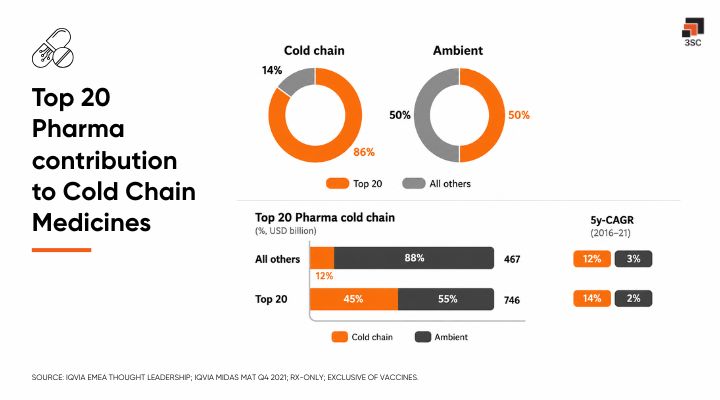
Cold-chain dependency creates three operational pressures:
1. Thermal endurance becomes a strategic constraint
Packaging qualification is often based on expected transit duration plus a controlled safety margin. When a lane extends by several days, or when cargo waits at a congested hub, packaging endurance can become the limiting factor. The question is no longer simply whether a route is available; it is the whether the product, pack-out, lane, and handoff model can survive the revised journey
2. Compliance evidence becomes harder to maintain
Good Distribution Practice expectations require control, documentation, and investigation of excursions. In a stable network, evidence flows through known systems and partners. In a disrupted network, data may fragment across emergency carriers, alternative warehouses, and manual processes. That makes release decisions slower and increases the burden on quality teams.
3. Inventory buffers become less reliable
Safety stock can absorb some delay, but not all disruption. For short shelf-life therapies, country-specific packs, controlled drugs, or patient-specific advanced therapies, inventory flexibility is limited. When transport instability meets product specificity, continuity becomes far harder to protect.
Route Sensitivity Is a Network Design Issue
A resilient pharma network is not defined by how quickly it finds another route. It is defined by whether the alternative route has already been assessed, qualified, and connected to decision protocols.
In 2026, route sensitivity should be treated as a design variable. Supply chain leaders need to understand which products, markets, and lanes are most exposed to single-corridor dependency, limited cold-chain airport or port infrastructure, customs or regulatory bottlenecks, short packaging duration margins, constrained carrier availability, and low inventory cover at market level.
Each of these factors changes the response window. A high-margin cold-chain lane with multiple qualified options may tolerate disruption, while a single-source biologic moving through one critical hub may not. The practical implication is that risk segmentation must become more granular, combining product criticality, temperature range, patient impact, route volatility, and regulatory complexity into one operating view.
Digital Twins and Scenario Readiness
Digital twins are often discussed as advanced planning tools, but their value in pharma lies in decision readiness. A useful supply chain digital twin should connect routes, inventory, lead times, packaging duration, carrier options, temperature profiles, demand signals, and compliance constraints.
That allows teams to test disruption before it happens. The strongest use cases are practical:
- Rerouting impact: identifying which alternative lanes remain within validated thermal and regulatory limits.
- Inventory exposure: showing where market stock will fall below continuity thresholds.
- Packaging stress: testing whether existing pack-outs can withstand longer dwell and transit times.
- Release risk: estimating how missing or delayed temperature evidence affects batch disposition.
- Response playbooks: assigning actions before disruption escalates.
The aim is not only to predict every event. It is to reduce decision latency when assumptions break.
From Visibility to Response Design
Track-and-trace visibility is necessary, but it is no longer sufficient. A shipment dashboard that shows delay without recommending action is only a warning system. Pharma supply chains need response design: predefined decisions, accountable owners, approved alternatives, and quality-aligned escalation rules.
This requires closer integration between supply chain, quality, regulatory, procurement, and commercial teams. Route disruption cannot be managed in a transport silo because the trade-offs are cross-functional. A faster airfreight option may reduce thermal risk but increase cost. A new lane may protect supply but require quality approval. A market allocation decision may preserve patient access but affect revenue plans elsewhere.
Senior leaders should therefore ask whether their networks have:
- Qualified alternative lanes for critical products;
- Dynamic risk scoring by route and product;
- Live temperature and location data connected to escalation rules;
- Clear decision rights during disruption;
- Tested scenarios for route closure, carrier failure, and hub congestion.
These are not optional resilience features. They are operating requirements for a world where disruption is persistent.
Conclusion
Looking ahead, pharma supply networks will face continued pressure from geopolitical instability, climate events, trade restrictions, infrastructure constraints, and demand shifts toward biologics and advanced therapies. The cold chain will become wider, deeper, and more specialized.
The winners will not be companies with the most complex logistics networks. They will be companies that understand their fragility before a disruption exposes it. That means moving from static lane validation to continuous risk monitoring, from reactive escalation to rehearsed response, and from fragmented visibility to digital decision support.
Route disruption is the signal. The real issue is whether the supply network can protect product integrity, compliance, and patient continuity when the planned route is no longer available.