Key Takeaways
- Black Friday 2025 online sales are projected to reach $11.7 billion
- Predictive planning gives businesses a clear edge during peak demand
- Resilient supply chains stay steady when disruptions hit
- Accurate, connected data drives faster and smarter decisions
- Sustainable operations strengthen both reputation and results
- Agile execution turns market volatility into growth opportunities
Every November, as Black Friday sales begin, supply chain leaders prepare for one of the biggest tests of the year. What started in the United States as a post-Thanksgiving shopping day has now evolved into a global retail moment, with brands and consumers across regions treating it as a key buying event. What was once a single busy weekend has become a high-stakes period where every decision counts. Today, Black Friday is about more than discounts, it’s where smart planning, accurate data, trusted partners, and resilient supply chains determine who leads and who lags behind.
2025 Black Friday Key Insights, Statistics & Trends
To better understand how shoppers are approaching the big day, Drive Research surveyed more than 1,200 consumers about their 2025 Black Friday plans, habits, and spending.
- 81% of Black Friday shoppers would consider using AI to help with holiday shopping
- Special discounts (80%) is the top reason people plan to shop on Black Friday
- 71% of people will shop online this Black Friday, while 29% will shop in-person
- Nearly 1 in 4 Black Friday shoppers (24%) will spend $1000 or more on holiday shopping
- 1 in 3 in-person Black Friday shoppers will start shopping in-store on Thanksgiving Day 2025 (33%)
- Most people will shop in-person at Walmart (71%) and Target (56%) on Black Friday
- Amazon is the go-to destination for Cyber Week in 2025, with 94% of shoppers planning to buy there
- 71% of people will shop online this Black Friday, while 29% will shop in-person
- Nearly 1 in 4 Black Friday shoppers (24%) will spend $1000 or more on holiday shopping
- Most 2025 Black Friday shoppers (76%) will spend the same or less money on holiday shopping compared to 2024
- Rising costs of living (70%), rising costs of groceries (57%), and high inflation (54%) are among the top reasons
- Black Friday shoppers will spend less money on holiday shopping in 2025
- Over 1 in 10 Black Friday shoppers have part of their pay go automatically into a holiday fund
- Clothing and accessories is the top purchase category for both in-person Black Friday shopping (80%) and online (77%)
- Most Black Friday shoppers plan to purchase electronics either in-person (70%) or online (69%)
- More people will purchase household appliances in-person on Black Friday (38%) than online (30%)
- Over 1 in 3 people will purchase gift cards on Black Friday whether it be in-store (37%) or online (36%)
- In 2025, nearly every Cyber Week shopper (94%) plans to shop Amazon on Black Friday and/or Cyber Monday – a 9% jump from our 2024 survey
- Most people will shop in-person at Walmart (71%) and Target (56%) on Black Friday
From Shopping Spree to Supply Chain Showdown
Black Friday now represents a seamless blend of physical and digital shopping, where in-store experiences, e-commerce journeys, and social marketplace interactions converge. For 2025, global Black Friday sales are projected to rise by about 11% year over year, reflecting stronger demand and increased online shopping activity. But beneath the surface of that sales boom lies a complex operational challenge. Inventory management, last-mile delivery, labour shortages, and unpredictable global events are converging, testing how agile, connected, and intelligent supply chains truly are.
This year, global tensions have quietly reshaped the retail landscape. The Red Sea shipping crisis disrupted major trade routes, pushing up container costs and reducing capacity by as much as 20 %. Meanwhile, the escalating U.S.–China tariff war has sent shockwaves through global supply chains, leading to a roughly 28 percent year-on-year drop in U.S. containerised imports. Rising oil prices, partly influenced by ongoing Middle East instability have also inflated freight and delivery costs across the board.
Amid these pressures, resilience has emerged as the defining capability that separates prepared retailers from vulnerable ones. In a world where volatility has become the norm, retailers that can adapt quickly by diversifying suppliers, optimizing logistics, and building supply chain visibility will not only survive but gain a competitive edge over those still reacting to disruption.
The Core Challenges: Agility, Visibility, and Precision
Before diving into how resilience sets successful supply chains apart, it’s important to understand the challenges that continue to test them.
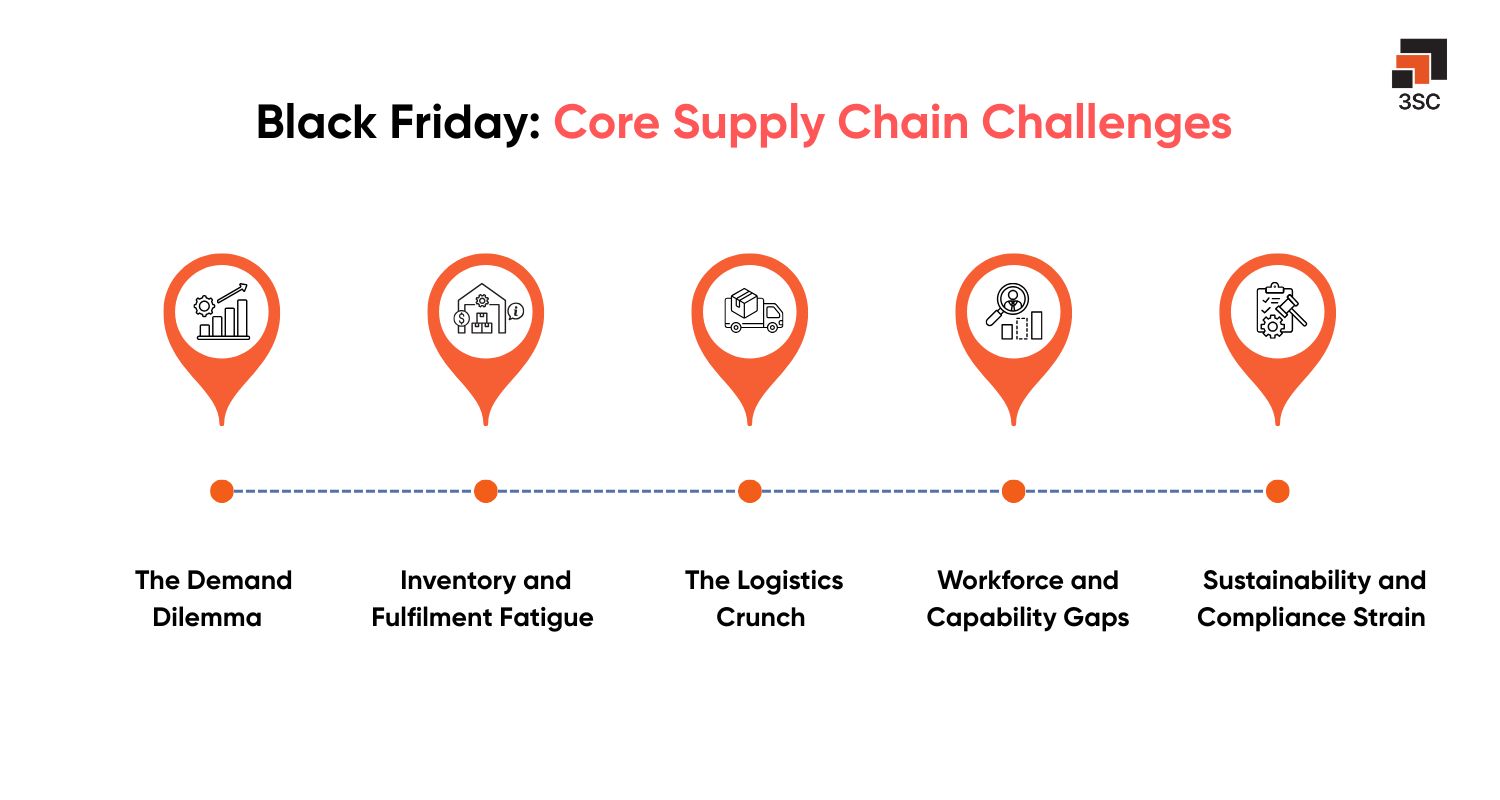
1. The Demand Dilemma
Predicting what, when, and where consumers will buy has never been more complex. Inflation may be stabilizing, but spending patterns remain unpredictable. While some consumers start shopping as early as mid-November, others hold out for last-minute flash deals. The surge of social commerce, where shoppers buy directly from platforms like TikTok and Instagram, has made demand forecasting even trickier.
For businesses, AI-powered demand sensing and demand forecasting have become indispensable. Retailers using predictive analytics and Integrated Business Planning (IBP) platforms can identify patterns in real time and adjust inventory distribution dynamically, ensuring products are available exactly where demand spikes.
2. Inventory and Fulfilment Fatigue
In 2025, the line between distribution centre and storefront has blurred. Retailers are now treating every store, warehouse, and partner outlet as part of an extended fulfilment ecosystem.
The risk of stockouts still looms large, but the bigger trap is overstocking. Excess inventory means higher carrying costs, markdowns, and wasted shelf space, all of which eat into margins. To combat this, businesses are leveraging AI-driven inventory optimization tools that continuously analyse sales velocity, consumer behaviour, and supply lead times.
Moreover, the rise of nearshoring has reshaped supply chain design. Many companies have shifted production closer to demand centres, particularly in Latin America and Eastern Europe, cutting lead times and reducing exposure to global disruptions.
3. The Logistics Crunch
If the warehouse is the heart of the supply chain, then last-mile delivery is its pulse, and this is where the real pressure builds during Black Friday. The surge in online orders pushes courier networks and sorting hubs to their limits.
To stay ahead, leading brands are investing in autonomous warehousing and AI-powered routing systems, allowing them to dynamically predict congestion and reroute shipments in real time. Digital twin simulations, once an emerging technology, are now mainstream helping logistics teams test “what-if” scenarios before the chaos hits.
4. Workforce and Capability Gaps
Black Friday puts intense pressure on the people behind the supply chain. Even with rising automation, warehouses still rely on trained operators, and seasonal labour shortages make it harder to keep pace. The strikes across the U.S. and Europe in early 2025 showed how quickly operations can be disrupted.
To stay prepared, companies are investing in upskilling, better training and more flexible staffing models, while adding automation where it genuinely reduces manual strain and keeps throughput steady during demand spikes.
5. Sustainability and Compliance Strain
As Black Friday expands globally, consumers expect more responsible operations, from packaging choices to delivery methods. According to a Gartner study, 58 percent of consumers prefer brands that demonstrate measurable environmental impact, even during discount-heavy events like Black Friday. At the same time, new regulations around emissions and waste are raising the bar for compliance.
Companies are responding with recyclable packaging, cleaner delivery options and digital tools that track carbon impact integrating sustainability and compliance into everyday operations rather than treating them as add-ons.
As discussed, addressing these challenges is essential but lasting resilience comes only from the advanced capabilities and tools that elevate planning, visibility, and decision-making across the entire supply chain. And this is exactly where leading organisations pull ahead
From Reactive to Ready: How Leading Supply Chains Stay Ahead of Black Friday Volatility
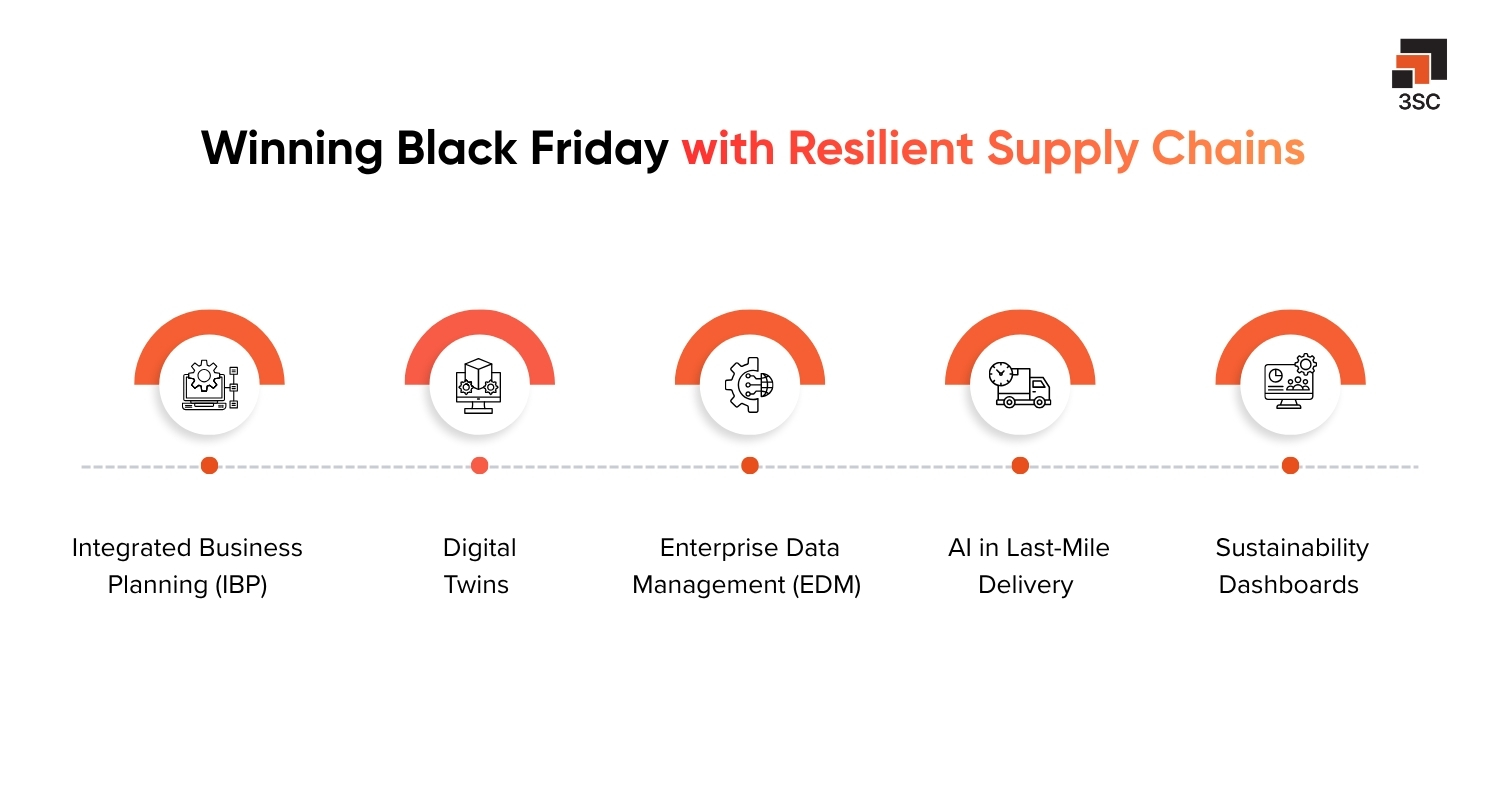
The top-performing businesses are not merely reacting to disruptions; they are designing for them. Here is how:
- Integrated Business Planning (IBP): By connecting sales, operations, and finance in real time, Integrated Business Planning enables unified demand forecasting, sensing and end-to-end visibility. This allows companies to plan not just for volume, but for profitability turning planning into a strategic advantage.
- Digital Twins: These virtual replicas of supply chain networks let companies simulate scenarios like port congestion or weather-related delays. With foresight into possible disruptions, they can proactively design contingency plans and stay a step ahead of chaos.
- Enterprise Data Management (EDM): EDM establishes a single source of truth across systems, breaking down data silos and improving decision-making accuracy. The result is faster alignment, clearer insights, and more confident execution across the enterprise.
- AI in Last-Mile Delivery: Predictive routing and demand clustering powered by AI help reduce delivery times while optimizing fuel use and lowering emissions. This makes last-mile operations both more efficient and more sustainable.
- Sustainability Dashboards: With carbon calculators and traceability tools, businesses can track, measure, and report their environmental impact transparently. This not only supports compliance but strengthens brand trust with consumers who value responsible operations.
In the end, resilient supply chains aren’t built by chance, they’re engineered through data, foresight and a commitment to adapt faster than disruption itself.
The Black Friday Playbook: Compete Smarter, Not Harder
As we move deeper into the era of intelligent planning, success this Black Friday will not come from who discounts the most but from who plans the best.
Businesses that combine predictive intelligence, digital collaboration, and agile fulfilment are not only surviving the chaos, but they are also thriving in it. They understand that every disruption is also an opportunity to innovate, to build trust and to deliver experiences that go beyond the checkout page.
Because at its core, Black Friday is not just a battle for sales; it is a benchmark for resilience. This year, the supply chains that navigate the chaos with foresight, flexibility and intelligence will define the future of retail.
Partner with 3SC for Intelligent, Resilient Supply Chains
At 3SC, we help businesses move beyond traditional planning with AI-driven insights, end-to-end supply chain visibility, and collaborative supply chain solutions. From reducing risks to improving agility and resilience, our expertise ensures your supply chain isn’t just prepared for today’s challenges but ready to thrive in tomorrow’s uncertainty.
Discover how 3SC can transform your supply chain into a strategic advantage.