Key Highlights
- Execution speed is now as critical as supply chain planning.
- Volatility requires constant coordination across the supply network.
- Dynamic planning helps rebalance production, inventory, and distribution.
- Integrated systems connect planning decisions with execution.
- Scenario planning helps anticipate and manage disruptions.
- Digital platforms and automation enable faster supply chain decisions.
The consumer-packaged goods (CPG) industry is entering a phase of sustained expansion. The global market is projected to grow by nearly $1.5 trillion between 2024 and 2029, at a CAGR of 4.9%, driven by the rapid rise of e-commerce and direct-to-consumer models. As growth accelerates, so does the complexity of operating in this environment.
In 2026, volatility is no longer an occasional disruption, it is the baseline. Demand signals shift faster than forecasting cycles can respond, retail promotions change overnight, and supplier constraints emerge without warning. At the same time, organizations are expected to maintain service levels while protecting margins.
Over the past decade, many CPG companies have invested heavily into Integrated Business Planning (IBP) to align commercial, financial, and supply chain teams. The objective was clear: ensure that strategy, demand, supply, and financial targets operate from a common plan. In many cases, IBP has delivered that alignment.
But for supply chain leaders, the challenge is not just planning for this volatility but maintaining stability while everything around the organization continues to move.
This is where the focus shifts, from alignment to execution.
Why Strategic Alignment Still Matters
Before execution can be strengthened, it is important to acknowledge what Integrated Business Planning (IBP) continues to do exceptionally well.
For CPG companies managing complex product portfolios, multiple channels, and global supply networks, this alignment is critical. Without it, organizations risk operating in silos, sales pursuing growth targets that supply cannot support, or operations optimizing efficiency at the expense of customer service.
At its core, IBP creates a structured framework where organizations align around a single, consensus-driven plan. Commercial teams bring forward demand assumptions, supply teams evaluate capacity and constraints, and finance ensures the plan supports revenue and profitability goals, it prevents fragmentation by ensuring that strategic decisions are made with full visibility across the business. It aligns the organization around a plan that spans months or quarters. It defines what the business intends to achieve and how resources will support that direction.
While IBP provides strong alignment at the planning level, the real challenge lies in translating that alignment into day-to-day execution. Bridging this gap requires a mechanism that continuously connects operations with strategy, this is where S&OE comes in.
S&OE: The Missing Link Between Strategy and Action
Where IBP defines the strategic direction, Sales and Operations Execution (S&OE) ensures that the organization stays on course when conditions change.
Its purpose is not only to rebuild the strategic plan but to orchestrate operational decisions that keep execution aligned with that plan.
In practice, this means establishing a governance structure where cross-functional teams review near-term performance, identify emerging risks, and make coordinated decisions before disruptions escalate.
For example, when a supply constraint appears, S&OE forums bring together demand planners, supply planners, commercial leaders, and finance to evaluate the situation collectively. Instead of each function responding independently, the organization determines the best course of action based on service priorities, financial impact, and operational feasibility.
This shift, from reactive firefighting to coordinated decision-making, is what allows leading CPG companies to maintain stability in volatile environments.
But governance alone is not enough. For S&OE to work effectively, organizations also need clear visibility into what is happening across their supply networks.
Building Resilience into Supply Chain
Volatility in 2026, has exposed a critical weakness in many CPG supply chains: the inability to respond effectively when disruptions occur.
To address this, organizations are refining their workflows by combining predictive insights, real-time signals, and scenario readiness, enabling them to identify risks early and respond in a coordinated manner. Its true value is realized when it is anchored in structured execution, where S&OE ensures that operational responses remain aligned with the strategic direction set through IBP.
Together, strategy and execution create a connected system, one that allows organizations to anticipate, adapt, and act with consistency even as conditions change.
The result is a supply chain that maintains stability in the face of volatility, turning resilience into a sustained competitive advantage.
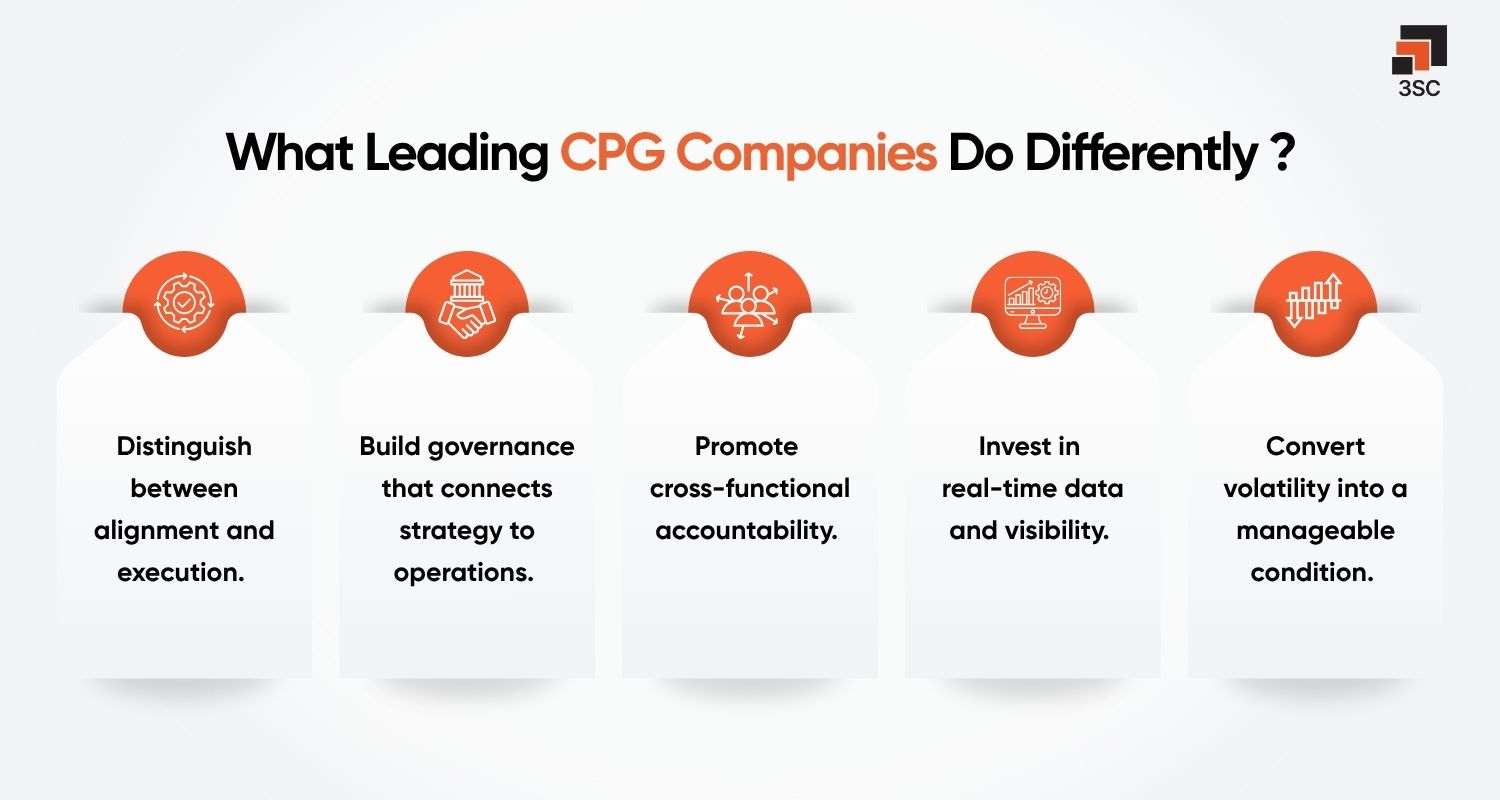
What Leading CPG Companies Are Doing Differently
This shift is reflected in how organizations are evolving their approach as:
1. Help distinguish between alignment and execution: Today, CPG Leaders understand that strategic alignment and operational execution serve different purposes. While IBP sets the strategic direction, S&OE ensures that day-to-day decisions keep the organization on track when disruptions occur.
2. Build governance that connects strategy to operations: These companies establish structured S&OE governance forums where operational decisions are reviewed against the priorities defined during IBP cycles. This ensures short-term responses do not drift away from long-term strategy.
3. Promote cross-functional accountability: Execution is treated as a shared responsibility across functions. Commercial, supply chain, and finance teams collaborate in operational decision-making so that service, cost, and revenue trade-offs are evaluated holistically.
4. Invest in real-time data and visibility: Instead of relying only on historical reporting, leading organizations deploy visibility platforms and analytics that provide early signals of supply chain risks, enabling proactive responses to disruptions.
5. Convert volatility into a manageable condition: By combining alignment, governance, collaboration, and visibility, CPG companies are developing the capability to navigate volatility without compromising service levels, margins, or operational credibility.
Together, these capabilities help leading CPG companies bridge the gap between alignment and execution, ensuring their supply chains remain steady even as market conditions continue to evolve.
The Future of Operational Synchronization
Looking ahead, the next wave of supply chain transformation will focus on continuous synchronization between strategy and operations.
Advances in artificial intelligence, predictive analytics, and digital supply chain platforms are already enabling faster decision cycles. These technologies can detect demand shifts, identify supply risks, and simulate response scenarios in near real time.
However, technology alone will not solve the execution challenge.
The organizations that succeed will be those that combine digital capabilities with disciplined governance, cross-functional collaboration and unified decisions. Technology can surface insights, but leadership structures must ensure that the right decisions are made quickly and collectively.
In this future state, IBP and S&OE will no longer operate as separate processes. Instead, they will function as interconnected layers of a single decision ecosystem, one that continuously aligns long-term strategy with short-term execution.
For supply chain experts, this shift represents an important evolution in how planning and execution are understood.
The goal is no longer just to create a strong plan. It is to maintain alignment between strategy and operations every day.