
The excitement around AI, automation, and predictive analytics is everywhere. In almost every conversation, there is strong interest in what these technologies can unlock.
Yet after most meetings, I find myself coming back to one question: what problem are we actually trying to solve? Because in my experience, the challenge is rarely about the tools themselves. AI will not deliver value if the right foundations are not in place.
Many organizations rush into adoption without first building clarity on purpose, outcomes, ownership, and readiness. That missing clarity often shows up later in execution. Leaders may discuss AI adoption at length, but the outcomes remain vague. Implementation then gets handed to teams without a clear goal, without enough context to trust the technology, and without space to experiment. The result is not transformation. It is amplified inefficiency, slower alignment, and quiet frustration.
Defining Your "Why" Clearly
Every successful AI deployment starts with a specific business problem. Not a tool. Not a trend. Not a broad ambition to “increase efficiency.” But vague objectives that rarely create meaningful outcomes. And the organizations that make real progress are the ones that narrow their focus to two or three clear goals, whether that means reducing supply chain costs, improving decision-making accuracy, or speeding up customer response.
This clarity does more than shape the project. It gives teams direction, aligns effort, and creates a practical way to measure progress. More importantly, it helps employees understand why AI matters to the decisions they make every day.
That is what separates momentum from stagnation. When AI is treated as a strategic endeavour rather than a technology rollout, adoption becomes easier to trust, easier to use, and far more likely to create lasting value. But lasting value takes time to build, which makes expectation-setting just as important as the technology itself.
Measurable impact often takes 12 to 18 months to emerge. When leaders communicate this honestly, they help prevent premature abandonment and keep teams invested, even when early results are modest.
This honesty also opens the door to a deeper conversation about what AI can and cannot fix. AI rarely creates transformation in isolation. More often, it reveals whether an organization is truly ready for it.
AI is a Mirror
This is something I have come to believe strongly: AI does not transform organizations on its own; it reflects them. It surfaces the strengths and gaps already present in processes, culture, and decision-making. When the foundation is weak, AI makes that weakness more visible and more costly.
Before deploying any tool, honest self-assessment matters more than vendor selection. Organizations need clarity on:
- Data that is clean, structured, and sufficient to support AI models
- Teams that are ready to act on AI insights with confidence
- Governance, accountability, and ethical guidelines that are clearly defined
- Infrastructure that can support new tools without compromising security or scalability
Getting these fundamentals right is what separates organizations that create value from those that spend money, create noise, and eventually stall.
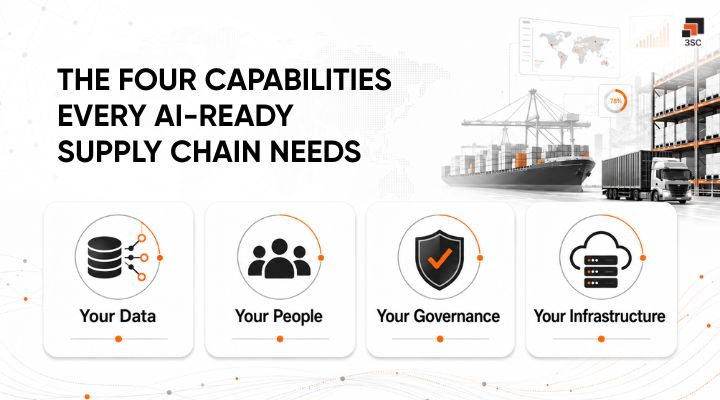
The Four Foundations
Once an organization has answered why it needs AI and has honestly assessed what AI will reflect, the next step is to strengthen the foundations that make adoption sustainable. If AI exposes how an organization already works, then data, people, governance, and infrastructure decide whether that exposure leads to progress or simply amplifies existing problems.
In my experience, these four areas determine whether AI becomes a real capability or remains another technology experiment.
1. Your Data
The first foundation is data, because every AI system is only as strong as the information it learns from and acts on. Poor data is one of the most common reasons AI initiatives quietly fail. The work here is unglamorous but essential: removing duplicates, aligning master data, standardizing formats across business units, and assigning clear ownership so quality is maintained over time.
Volume matters too. AI needs abundant and accurate data to perform well. Insufficient or biased datasets do not just limit performance; they produce confident wrong answers. In markets like India, compliance is also non-negotiable. Organizations must align with the IT Act and the DPDP Act 2023, treating data protection not as a checkbox but as a design principle.
A clean data foundation often exposes operational gaps that had been invisible for years. That exposure can be uncomfortable, but it is also valuable. It gives the organization a clearer view of what needs to be fixed before AI can create meaningful value.
2. Your People
AI But even strong data will not carry an AI initiative if people do not trust the tools or understand how to use them. AI initiatives rarely fail only in the model. More often, they fail in the room, where people resist, disengage, or quietly route around tools they do not trust. Cultural readiness is often the deciding factor, and it is almost always the most underinvested one.
Positioning AI as a collaborator rather than a performance monitor changes how people engage with it. Continuous training matters, but so does giving employees permission to question outputs, flag inconsistencies, and treat early mistakes as learning signals. Internal champions in each business unit can also make a substantial difference by translating AI insights into daily decisions.
Teams that understand where AI is reliable and where human judgment remains essential use it more effectively. That boundary is not a weakness to hide. It is something leaders should make explicit, because clarity builds confidence.
3. Your Governance
As people begin using AI more widely, governance becomes the structure that keeps adoption safe, consistent, and accountable. AI without governance is not just risky; it is a liability. Clear policies on what employees can and cannot do with AI tools, guardrails on what data can interact with third-party systems, and defined accountability when outputs are wrong or misinterpreted are not bureaucratic additions. They are what make sustained, trustworthy adoption possible.
Even organizations with excellent AI tools can struggle when incentives are misaligned and teams optimize for their own KPIs rather than shared outcomes. When governance includes shared accountability and collective goals, AI insights are more likely to lead to decisions rather than reports that sit unread.
Ethics and explainability belong here too. Bias, fairness, and transparency are not just aspirational principles. They are operational requirements for any AI system that influences consequential decisions.
4. Your Infrastructure
Finally, governance and ambition need to be supported by infrastructure that can actually carry the work. APIs, cloud systems, and enterprise platforms need to be compatible with new AI tools before deployment, not retrofitted after. Security posture must account for vulnerabilities that new integrations introduce. Contracts, SLAs, and cloud capacity should be built for the workloads of six months from now, not only for today.
The goal is not to replace legacy systems immediately. It is to enable them to work smarter, creating space for experimentation, iterative learning, and continuous improvement without destabilizing what already works.
When these four foundations come together, AI has a much stronger chance of moving beyond experimentation. It becomes part of how the organization thinks, decides, and improves.
The Real Advantage
Taken together, these foundations point to a larger truth about AI adoption in supply chains. Most organizations will implement AI in some form in the coming years. The real difference between leaders and laggards will not be which tools they choose, but how deliberately they prepare before they deploy.
What I have seen, again and again, is that capability is not built by waiting for perfect conditions. It is built by piloting thoughtfully, allowing early failures to surface, and treating those failures as learning rather than embarrassment. Small, visible failures during pilots are not setbacks. Managed well, they accelerate organizational learning in ways that smooth rollouts rarely can.
For leaders, the challenge is to make AI part of how the organization works, not just another layer of technology on top of existing processes. The organizations that ultimately thrive are the ones that integrate AI into their culture, align it with the way people actually make decisions, and embed it into operations over time. Success is not measured by adoption dashboards alone. It is measured by better decisions, faster responses, and supply chains resilient enough to absorb the next disruption.
That is the real advantage. Clean data, empowered people, clear governance, and scalable infrastructure are not just preparation for AI. They are preparation for the kind of organization that can use AI wisely.