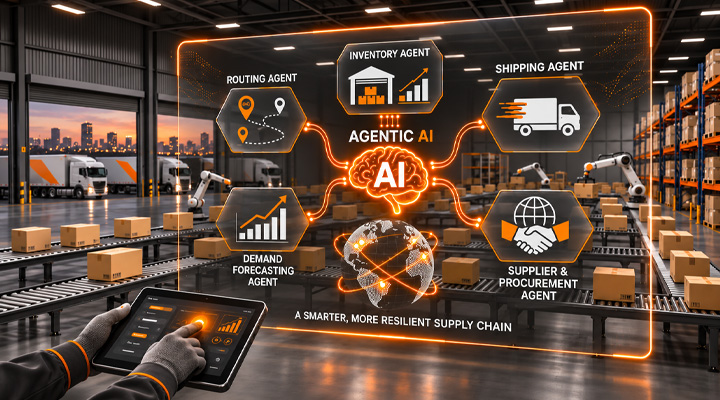
Agentic AI enables enterprises to manage supply chain operations through intelligent agents that monitor changing conditions, evaluate alternatives, and execute tasks within defined business rules. Its applications span demand planning, procurement, manufacturing, inventory, and logistics, helping businesses improve operational efficiency, strengthen coordination across functions, and respond to disruptions while maintaining appropriate human oversight.
Key Takeaways
- Agentic AI helps enterprises connect supply chain planning with operational execution through intelligent, autonomous agents.
- AI agents monitor changing demand patterns and coordinate forecast adjustments and inventory replenishment.
- Procurement and manufacturing agents support supplier coordination, purchase order processing, and production scheduling.
- Agentic AI improves inventory allocation, warehouse operations, and logistics coordination by evaluating operational requirements.
- Successful Agentic AI adoption requires connected enterprise systems, reliable data, clear decision boundaries, and human oversight.
A sudden increase in customer demand should be good news for any business. But for a manufacturer already operating near capacity, it can quickly become a supply chain challenge.
The demand planning team needs to revise its forecast. Procurement must confirm whether suppliers can provide additional materials. Production teams need to adjust their schedules, while logistics must determine how the additional orders will reach customers on time.
Each team knows what needs to happen. The difficulty lies in coordinating these activities quickly enough to respond to the opportunity.
This is a familiar problem for enterprises managing complex supply chains. Over the years, businesses have invested in sophisticated planning systems, real time visibility, and advanced analytics. Yet many operational decisions still depend on people gathering information, evaluating alternatives, and coordinating actions across multiple systems.
Agentic AI offers a new way to manage this complexity. Let’s understand the Role of Agentic AI in Supply Chain Management.
Understanding the Role of Agentic AI in Supply Chain Management
Think about how a typical supply chain exception is handled today. A system identifies a potential stockout, a planner reviews the alert, procurement checks supplier availability, and someone eventually initiates the required replenishment.
The information was available from the beginning. What took time was completing the work that followed.
Agentic AI changes how this process can operate.
AI agents can monitor operational information, evaluate available options, and execute specific tasks across connected systems within established business rules. Unlike predictive AI, which primarily provides forecasts or recommendations, agentic systems can coordinate multiple activities towards an operational objective.
The growing interest in these capabilities is reflected in Gartner's prediction that by 2030, 50% of cross functional supply chain management solutions will use intelligent agents to autonomously execute decisions, compared with approximately 5% in 2025.
For enterprises, the opportunity becomes clearer when we consider where these capabilities can be applied across everyday operations.
Key Agentic AI Use Cases in Enterprise Supply Chain Operations
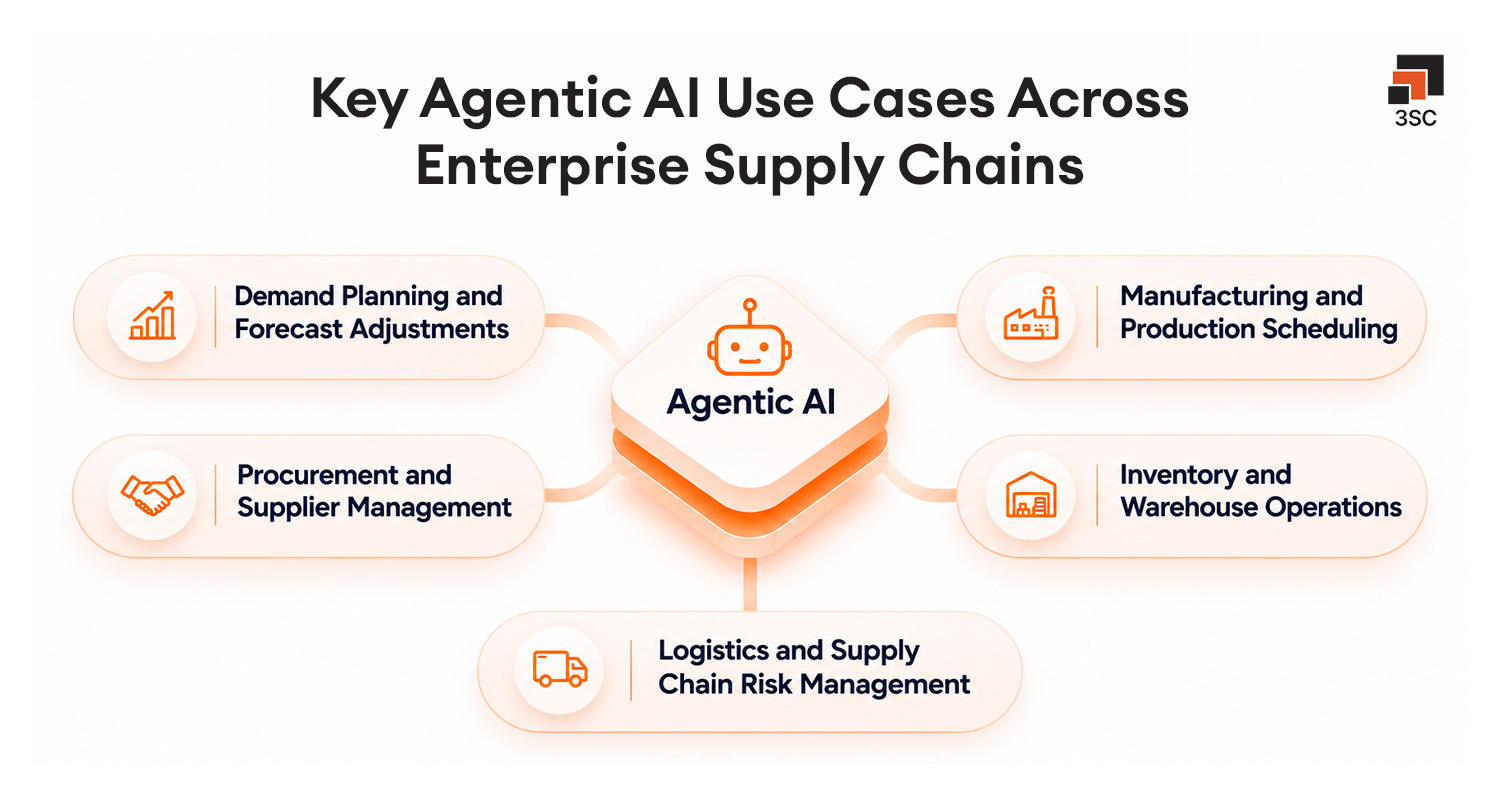
1. Demand Planning and Forecast Adjustments
Consider a consumer goods company preparing for a seasonal promotion. Its forecast indicates strong demand across several markets, and inventory has been allocated accordingly.
A few days into the promotion, one region begins selling faster than expected, while another performs below forecast. The original inventory allocation now needs adjustment.
A demand planning agent can monitor sales performance, promotional activities, and inventory availability to identify these changes. It can then evaluate revised requirements, assess available stock, and coordinate replenishment activities.
Adjustments within approved parameters can be executed automatically, while significant changes are presented to planners for review. This helps businesses respond to changing demand while ensuring that updated plans are supported by appropriate replenishment decisions.
2. Procurement and Supplier Management
Procurement involves continuous coordination across suppliers, purchase orders, delivery commitments, and contractual requirements. When an exception arises, several activities may need to be reviewed before corrective action can begin.
Suppose a supplier informs a manufacturer that a critical component will arrive four days late. A procurement agent can identify affected orders, evaluate approved alternative suppliers, and compare lead times, pricing, and contractual conditions.
Depending on its authority, the agent can initiate a revised purchase order or prepare an alternative sourcing recommendation for approval.
Similar applications include supplier onboarding, invoice validation, and supplier performance monitoring. These capabilities help procurement teams manage routine activities more efficiently while ensuring that changes in material availability are communicated to manufacturing operations.
3. Manufacturing and Production Scheduling
Manufacturing schedules depend on material availability, equipment capacity, and customer delivery commitments. A change in any of these factors can affect the wider production plan.
Consider an electronics manufacturer facing a delay in a component required for multiple products. Planners must decide whether to postpone production, prioritise products with available materials, or change the manufacturing sequence.
Agentic AI can evaluate these alternatives against current operational constraints and recommend or initiate permitted scheduling adjustments.
In facilities with connected equipment, maintenance agents can also identify potential equipment issues and coordinate maintenance activities with production requirements. This enables manufacturing teams to manage operational changes while maintaining control over production priorities and delivery commitments.
4. Inventory and Warehouse Operations
For enterprises operating multiple warehouses, inventory availability often depends on where products are stored.
A business may have sufficient stock across its network but still experience shortages in high demand locations while carrying excess inventory elsewhere.
An inventory agent can assess stock positions, demand requirements, replenishment lead times, and transportation costs to identify redistribution opportunities.
Before initiating an approved transfer, it can evaluate whether the movement would affect inventory availability at the originating location.
Within warehouses, agents can also support order prioritisation, inventory placement, and picking workflows based on changing fulfilment requirements. These applications help businesses use available inventory and warehouse capacity more effectively while preparing orders for timely dispatch.
5. Logistics and Supply Chain Risk Management
Even when products are ready for dispatch, transportation disruptions can affect delivery commitments.
Consider a shipment carrying critical materials that becomes delayed at a major port. The logistics team must assess affected orders, alternative inventory availability, transportation options, and additional costs.
A logistics agent can evaluate these factors and initiate permitted route adjustments or prepare alternatives requiring human approval.
Agentic AI can also support risk management by monitoring supplier performance, geopolitical developments, and transportation conditions to identify emerging disruptions.
By connecting risk signals with affected orders, materials, and available response options, agents can help businesses determine where intervention is required. This improves coordination between logistics and risk management activities, allowing enterprises to address operational disruptions while protecting customer commitments.
What Does It Take to Implement Agentic AI Successfully?
The applications discussed above depend on one essential requirement: Agents must have access to accurate information and clearly defined authority.
A replenishment agent working with incorrect inventory records could initiate unnecessary orders. A logistics agent operating without cost restrictions could select an expensive transportation alternative that provides little business benefit.
Enterprises therefore need reliable integration between planning and execution systems, consistent operational data, and appropriate governance.
It is equally important to identify where autonomous execution makes practical sense. Repetitive activities with clear rules and measurable outcomes may be suitable starting points. Decisions involving significant financial commitments, regulatory requirements, or strategic supplier relationships should retain appropriate human oversight.
Businesses can evaluate success through improvements in operational costs, fulfilment performance, inventory efficiency, and the time required to resolve exceptions. The objective should be to expand autonomy where it demonstrates reliable business value.
Conclusion: Making Enterprise Supply Chain Decisions Count
Enterprise supply chains depend on thousands of decisions made across planning, procurement, manufacturing, inventory, and logistics. The quality of those decisions matters, but so does the ability to implement them before circumstances change.
Agentic AI creates an opportunity to improve how these activities are coordinated, allowing defined operational work to progress with fewer delays between functions. Its value will ultimately depend on whether businesses can achieve more consistent execution, protect customer commitments, and improve the use of available resources.
For enterprises, the focus should be on making these capabilities part of everyday operations, where they can improve efficiency, reduce costs, and strengthen execution across functions. As Agentic AI becomes more deeply integrated into supply chain operations, its impact will depend on the reliability of the outcomes it delivers.
Strengthen Your Supply Chain Operations with 3SC's Agentic AI
Discover how 3SC helps enterprises connect planning with execution through intelligent AI agents that streamline operational workflows, support faster decisions, and improve coordination across supply chain functions. Explore opportunities to drive greater efficiency and measurable business outcomes.